Showing posts with label Alternative Energy. Show all posts

Thursday, June 13, 2013

Fracking The Amish

amish-mafiaJesus said, "Turn the other cheek". So if you are of the Amish faith you prefer to settle legal disputes within your own community, without litigation. In other words the Amish will not sue, and if you're a natural gas company, that's very good news. Turns out that whole "Amish Mafia" thing might be blown out of proportion.

To say that many natural gas companies are taking advantage of people of the Amish faith would be an understatement. In an article written for the New Republic, Molly Redden shares a story where an Amish couple was paid $10 an acre to have a natural gas company come in and start fracking. The couple was told that that was the best offer the company could make. Turns out neighboring farm were receiving upwards of $1,000 an acre. Rather than take legal action, because by their faith they cannot, the Amish couple admits they made a mistake and have to live with it.

This is just one of many similar instances. Not only did the Amish family lose out on a ton of cash, but they also put their farm, crops, and livestock in danger, and unknowingly jeopardized their livelihood due to the chemicals used in the fracking process. Check out the documentary Gas Land for a good idea of this.

The Amish couple did indeed make a colossal mistake, and should have done some investigating on their own. But they were also intentionally misled and outright lied to by a billion-dollar company that can afford to be honest. With the advent of hydraulic fracturing or fracking, this is the process of fracturing rock layers using a pressurized chemical mixture to release natural gas, natural gas companies are tapping into natural gas holds that were once unobtainable. This has created a massive boom in the natural gas industry and has taken the natural companies to Ohio, Pennsylvania, and West Virginia, places with large Amish populations .

With the knowledge that the Amish will not sue, this really opens the door for gas companies to do whatever they want without the risk of legal action. The impact of this is enormous. Other than outright lying about land value, let's say a lease ends and the company just keeps on fracking; the Amish can do nothing legally. It is easy to see how this can get really bad and fast.

The Amish do have certain options though. For example, one Amish family that was a victim of an undervalued lease took the gas company to court to simply void the lease. What makes this acceptable for the Amish couple is that there is no money involved - they just want the gas company to leave.

This isn't capitalism; this is wrong. From causing earthquakes to lighting water on fire, fracking has serious health and environmental complications not entirely understood yet. People But if people are willing to take these enormous risks with their land, they should at the very least be paid well for it. Those who constantly step up to defend the actions of oil companies should ask themselves; if gas companies willing to mislead, ripoff, and outright break contracts with the Amish, is there anything these scumbags won't do?

Source: New Republic

Andrew Meggison was born in the state of Maine and educated in Massachusetts. Andrew earned a Bachelor's Degree in Government and International Relations from Clark University and a Master's Degree in Political Science from Northeastern University. Being an Eagle Scout, Andrew has a passion for all things environmental. In his free time Andrew enjoys writing, exploring the great outdoors, a good film, and a creative cocktail. You can follow Andrew on Twitter @AndrewMeggison

The post Fracking The Amish appeared first on Gas 2.

http://gas2.org/2013/06/13/fracking-the-amish


allvoices

Thursday, June 6, 2013

United Airlines Buys Big Into Biofuels

Could the move help clean up a notoriously dirty industry?
UnfinishedPortraitmaker/Flickr

UnfinishedPortraitmaker/Flickr

United Airlines is taking a significant step forward in its use of biofuel with a plan to buy 15 million gallons of the stuff during the next three years.

The airline signed an agreement with AltAir Fuels to buy fuel it will use on flights departing Los Angeles beginning next year. United says the renewable jet fuel is "price competitive" with the fuel now used by airlines and should, on a lifecycle basis, reduce greenhouse gas emissions by at least 50 percent.

"This is a great day for United and the aviation biofuels industry," Jimmy Samartzis, the airline's director of environmental issues, said in a statement.

The news comes after a period of relative quiet about the use of aviation biofuel. There was a flurry of activity in the time between 2009 and 2011 as airlines around the world announced demonstration flights and passenger flights using a variety of biofuels. Even the military was burning biofuel in fighter jets. But the high cost of alternative fuels at the time made it unlikely cost-conscious airlines would embrace them for the long term.

To keep reading, click here.

http://climatedesk.org/2013/06/united-airlines-buys-big-into-biofuels


allvoices

Wednesday, April 3, 2013

The Drought Is Drying Up All Our Ethanol

After getting slammed last summer, ethanol producers are hoping to catch a break-but their fate is far from settled.
BrotherMagneto/Flickr

BrotherMagneto/Flickr

Bill Pracht has bad memories of last summer. "The drought was so bad here that the corn was just decimated," he recalls of the farm country around Garnett, Kan., where he oversees East Kansas Agri-Energy, an ethanol plant. "Many fields were zero."

In August, corn prices hit their highest level ever, driven mainly by the severe drought that crippled America's corn belt. By October, Pracht could see that he was spending more on corn than he could make with ethanol, and with no relief in sight, he began to have doubts about keeping the plant open.

"We knew we'd be wasting money," he says.

So, he pulled the plug, shuttering the plant and laying off twenty employees until conditions improve enough to make churning out what was until recently one of the nation's fastest-growing fuel sources profitable again. And as the EPA nears a final decision on new regulations that would require oil companies to use more ethanol in their gasoline mixes, Pracht's story illustrates a risk of increasing reliance on corn-based fuels in a warming world.

Pracht isn't alone: Over the last year, nearly 10 percent of the nation's ethanol plants have shut down. Annual corn yields came in almost a third lower than projected, according to the USDA, driving record-high corn prices that are likely to continue to rise into 2013, up to 19 percent higher than 2011-2012 averages. Overall, 2012 was the first year since 1996 (another drought year) in which total ethanol production decreased (by 4.5 percent), reversing a trend of exponential growth that's lasted almost a decade, according to the federal Energy Information Administration:

Tim McDonnell

Tim McDonnell

In February, USDA Chief Economist Joseph Glauber blamed drought for "one of the most unfavorable growing seasons in decades" in testimony before the Senate's Committee on Agriculture, Nutrition, and Forestry in February.

But despite the pain of 2012 and some grim predictions from NOAA about the months ahead (drought could lift in the eastern reaches of the Corn Belt and Pracht's region of Kansas, but worsen elsewhere in the state and to the west), a report on Thursday from the USDA predicts that corn growers will plow into the coming season with gusto: 97.3 million acres of corn are expected to be planted in 2013, up six percent since before the drought and the most acreage since 1936.

Courtesy Bill Pracht

Courtesy Bill Pracht

That should be a sign of hope for the ethanol industry, says Joseph Glauber, the USDA's chief economist; if weather conditions improve and the whole crop comes in, corn prices could drop a third by year's end. But he cautions that ethanol ain't out of the woods yet: If conditions like the first three months of 2013 persist, he says, ethanol production could fall by another eight percent this year.

"As much as anything it's related to the drought," he says.

For that reason, last week's USDA report came as a huge relief to Bob Dinneen, president of the Renewable Fuels Association, which represents the ethanol industry. Dinneen is hopeful the drought improvements NOAA forecasts for Iowa and Minnesota will spread southwest to Nebraska and Kansas, where the forecast is less optimistic.

"In any kind of normal weather year, we'll have a bin-busting season," Dinneen says. "You're always concerned. You don't want to see another [drought], but this is a time of year when everybody's optimistic."

Of course, how the season will pan out is still far from settled. The EIA also projects a further drop in total ethanol production this year of about 0.9 percent, much less severe than Glauber's prediction but enough to highlight the uncertainty producers face going into the summer, and the vulnerability of the ethanol industry to variable climate conditions.

For ethanol, growth is also limited by what's known as the "blend wall;" because only a relatively small fraction of cars can run well on ethanol-based fuel, ethanol can comprise no more than ten percent of the total fuel supply-a ceiling Dinneen says his group is pushing aggressively to raise. At the same time, President Obama signaled last month a desire to shift away from corn ethanol with heavy investments in advanced, non-corn biofuels-from things like municipal solid waste or woody biomass, sources that could prove more resistant to drought than corn-via his proposed Energy Security Trust.

Still, Glauber says, for the time being ethanol eats up forty percent of US corn, which leaves it vulnerable to bad weather and subsequent shifts in grain supplies: "Ethanol is a huge driver of corn demand. All of a sudden, there are much higher corn prices when you have a drought."

As long as climate change is a factor, the EIA reports, more and more ethanol producers are adopting oil recovery methods to squeeze more power out of their corn, increasing the chances of staying profitable in a time of unpredictable weather.

For Bill Pracht, those advances can't come soon enough. He hopes to be able to re-open his plant by September, keeping a skeleton crew on in the meantime so that the plant can spring back into action when the price is right.

"When Mother Nature cooperates," he says, "we'll be able to start it up and get back to where we were before."

http://climatedesk.org/2013/04/the-drought-is-drying-up-all-our-ethano


allvoices

Tuesday, March 19, 2013

KLM To Offer Weekly Cooking Oil-Fueled Flights

klmThe Dutch airline company KLM has started powering planes with a fuel mixture that is 25% used cooking oil, and 75% jet fuel (or at least, at least it was made from cooking oil). These regular flights represent a big step forward in alternative fuel flight.

The cooking oil used is obtained from restaurants in the U.S state of Louisiana. The oil was formerly used to fry catfish, cracklins, and other treats. After being used to prepare your food, it is refined at a plant near Baton Rouge, Louisiana, then carried to New York for use in the passenger jets. I'm sure it would feel good to eat at a restaurant that donates its oil to help reduce emissions.

Some believe that it smells like fast food, but, it is claimed to be totally safe for the jets, and reduce emissions by up to 80%. Using it is just like using jet fuel, and it is unnoticeable to pilots. These advantages are wonderful.

As usual, there is a downside, as most new technologies require work to get off the ground: The cooking oil-based fuel is cost-prohibitive. It may be difficult to expand this to struggling airlines that can hardly afford basic, normal operation. But if the costs come down, this could be a very reasonable response to ever-increasing oil prices.

"A lot still has to happen before biofuel will be available on a large scale and for it to be economically competitive in relation to fossil-fuel kerosene," KLM said in a statement. "We cannot achieve this alone. We absolutely need the commitment and support of all the relevant parties: business, government and society.".

The jets used are of the Boeing 777 type, and they will undergo 25 transatlantic test flights, as other jets have done.

Source: BBC

The post KLM To Offer Weekly Cooking Oil-Fueled Flights appeared first on Gas 2.

http://gas2.org/2013/03/19/klm-to-offer-weekly-cooking-oil-fueled-flig


allvoices

Wednesday, February 20, 2013

How the US Navy is Leading the Charge on Clean Energy and Climate Change

Damn the do-nothing Congress. The Navy is going full steam ahead on green energy.
USNS Henry J. Kaiser delivers a 50-50 blend of advanced biofuels. Official U.S. Navy Imagery/Flickr

USNS Henry J. Kaiser delivers a 50-50 blend of advanced biofuels. Official U.S. Navy Imagery/Flickr

Increasingly, the US Navy is leading the charge towards clean energy, which can in turn impact national security and even climate change. Through investments in biofuels, construction of a more energy-efficient fleet, forward thinking about issues like rising sea levels and a melting Arctic, and commitments to reduce consumption and reliance on foreign oil, the Navy is leading the charge of a vast energy reform effort to "change the way the US military sails, flies, marches, and thinks."

Please join host Chris Mooney for the next installment of Climate Desk Live on Wednesday February 27 at 9:30a.m, where he'll discuss the Navy's charge towards energy independence with Dr. David W. Titley, retired naval officer who led the US Navy's Task Force on Climate Change, Capt. James C. Goudreau, Director, Navy Energy Coordination Office, and Julia Whitty, environmental correspondent for Mother Jones whose cover story on this topic appears in latest issue of the magazine.

Event Details:
Date: February 27, 2013, 9:30 a.m.
Location: University of California Washington Center, 1608 Rhode Island Avenue, NW, Washington, DC
Please RSVP to cdl@climatedesk.org
About Dr. David W. Titley:

Dr. David W. Titley is a nationally known expert in the field of climate, the Arctic, and National Security. He served as a naval officer for 32 years and rose to the rank of Rear Admiral. Dr. Titley's career included duties as Oceanographer and Navigator of the Navy and Deputy Assistant Chief of Naval Operations for Information Dominance. While serving in the Pentagon, Dr. Titley initiated and led the US Navy's Task Force on Climate Change. After retiring from the Navy, Dr. Titley served as the Deputy Undersecretary of Commerce for Operations, the Chief Operating Officer position at the National Oceanic and Atmospheric Administration. Dr. Titley has spoken across the country and throughout the world on the importance of climate change as it relates to National Security. He was invited to present on behalf of the Department of Defense at both Congressional Hearings and the Intergovernmental Panel on Climate Change (IPCC) meetings from 2009 to 2011.

About Captain James C. Goudreau:

Captain James C. Goudreau serves as the Director of the Navy Energy Coordination Office. His sea duty and overseas assignments include: Assistant Supply Officer onboard USS REASONER (FF 1063) and USS NIMITZ (CVN 68), Supply Officer, USS THE SULLIVANS (DDG 68) and Supply Officer, Joint Maritime Facility, St. Mawgan in Cornwall, United Kingdom. His most recent assignment was as the Assistant Chief of Staff for Logistics at Expeditionary Strike Group Seven and Amphibious Force Seventh Fleet Based in Okinawa, Japan. Captain Goudreau's ashore tours include: Naval Air Station Key West, FL; Naval Inventory Control Point, Philadelphia, PA as the P-3 Weapons Team Lead and Director of Aviation Industrial Support; Fleet and Industrial Supply Center San Diego as Site Director, Fleet Readiness Center Southwest; and Commander, Defense Logistics Agency North Island. Captain Goudreau is a member of the Defense Acquisition Corps (formerly the Acquisition Professional Community) and is qualified as a Naval Aviation Supply Officer and as a Surface Warfare Supply Corps Officer. He has been awarded the Meritorious Service Medal (three awards), Navy Commendation Medal (five awards), Navy Achievement Medal (two awards), and various campaign and unit awards.

http://climatedesk.org/2013/02/how-the-us-navys-clean-energy-evolution


allvoices

Friday, January 25, 2013

The Impact Of Fracking On America's Economy... From Space

See that cluster of lights by North Dakota? That's the result of fracking. Six years ago that light cluster did not exist. The reason is over the past years natural gas extraction though the use of fracking has increased exponentially as a result of the push for alternative fuel use and technological achievements.

Fracking is the controversial method of extracting natural gas from shale rock using a chemical and water mixture. Depending on the methods used, some 29% of the gas being extracted can go to waste-or rather, into creating this light show.

That light cluster is fire of natural gas burning as companies work all night to extract resources from the Bakken formation under North Dakota; a place whose citizens now call the "Kuwait on the prairie".

The natural gas rush has been so sudden that North Dakota now has the lowest unemployment rate in the country - more than 41,000 workers got jobs there between 2008 and 2012. Additionally, seven years ago, the U.S. was importing 60% of its oil. Now oil imports are down to 42%. The Bakken fields play a major role in this.

Natural gas is indeed making an impact, be it for better or for worse, and an impact that is now visible from space! The picture was taken by NASA's Earth Observatory, which orbits the planet twice a day some 512 miles up.

Source: news.yahoo.com

Andrew Meggison was born in the state of Maine and educated in Massachusetts. Andrew earned a Bachelor's Degree in Government and International Relations from Clark University and a Master's Degree in Political Science from Northeastern University. Being an Eagle Scout, Andrew has a passion for all things environmental. In his free time Andrew enjoys writing, exploring the great outdoors, a good film, and a creative cocktail. You can follow Andrew on Twitter @AndrewMeggison

The post The Impact Of Fracking On America's Economy... From Space appeared first on Gas 2.
http://gas2.org/2013/01/25/the-impact-of-fracking-on-americas-economy-


allvoices

Sunday, January 20, 2013

Anti-ethanol Propaganda isn't 100% Wrong, Just 100% Crazy


Yesterday, I found myself clicking around a website that called itself "smarter fuel future". The distortion of facts to fit fictions and lies by omission committed throughout the site would be laughable, if they weren't so readily accepted by some of the mental midgets (mental little people?) that frequent this site's comments section from time to time.
I welcome the wingnut contingent, though. I'd like to say something here about keeping things honest and objective, but the reality is that a pageview's a pageview, right?
Right.
SO, in the interest of calling the anti-ethanol people out on their ridiculous bullshit keeping things honest, let's address some of the nonsense I read on the "smarter fuel" website. People with an IQ below 90, prepare to comment sarcastically without understanding the logic of what you are about to read.
The specific link that came to my attention from an ad on Gas 2 that was emailed to me by a confused reader. It linked to this page that talked about vehicles and small engines, so let's start there.
Please click the link and notice the heading "Decreased Fuel Economy". The "smarter fuel" site reminds us that "smarter" is a relative term almost immediately here, committing 2 logical fallacies at once. The "smarter fuel" website (like most ethanol detractors) points to the 100% correct fact that ethanol contains about 30% less energy by volume than petroleum gasoline. They specifically say "vehicles fueled with ethanol cover fewer miles per gallon than those running on conventional gasoline. The higher the ethanol blend, the lower the fuel economy, meaning consumers must fill up at the pump more frequently." The first fallacy in the "Decreased Fuel Economy" argument is here: the informal fallacy of equivocation, or "the misleading use of a term with more than one meaning or sense (by glossing over which meaning is intended at a particular time)." In this case, "fuel economy" and "miles per gallon" can mean many things, since "fuel" is a vague and intentionally misleading term, and "miles per gallon" implies "miles per gallon of gasoline". Think about the statement another way: if you substitute the vague term "fuel" with the specific term "petroleum gasoline", I think (hope) that arguments made against ethanol from a basis of "decreased petroleum gasoline economy" becomes a laughable objection to ethanol. They are literally saying "the higher the ethanol blend, the lower the amount of petroleum gasoline will be used", and there, RIGHT THERE, is their core complaint ... because they are either oil company employees or the idiot pawns of oil company marketers who never took (or, more likely, passed) a formal logic class.
Education FTMFW, amirite?
Beating a dead horse just a bit, I'd like to point out that (even if you accept that whoever wrote it simply too stupid to realize their logic is horribly flawed) this is strictly an appeal to short-sighted convenience, and places "more trips to the pump" ahead of concerns about foreign oil dependence, environmental damage that comes from extracting oil from the ground, the huge amounts of resource-draining government oil subsidies, the wars fought over a finite (non-renewable) energy source, and the numerous health problems associated with burning petroleum fuels. In scientific terms: all this anti-ethanol hysteria is crazy-talk.
Moving on, let's talk about the next heading, "Damage to Vehicles and Performance". The site says "Beyond the damage to your wallet, ethanol can also damage vehicles and affect performance - corroding metals, causing rubber to swell and causing engines to break down more quickly. Some ethanol blends should not be used on certain engines and motors at all. EPA's E15 waiver covers only 2001 and newer motor vehicles." All of that, by the way, is 100% true. Alcohols can dry out the organic rubber o-rings and fuel lines in many automotive fuel systems, causing them to crack, leak, and require replacement. If not enough fuel is getting to your engine because of a fuel leak, your car will stop running and require maintenance. You may need to replace several feet of rubber fuel lines with ethanol-safe line, at a retail cost of about $6/ft. O-rings cost a few cents.
That doesn't sound quite as scary as "break down", does it?
Those of you who are not too young or too senile to have long memories will recall that a lot of this bickering and fear-mongering sounds pretty similar to the hubbub raised in the 70s when the US government banned the use of lead as an octane-boosting fuel additive. The transition away from leaded fuels was fought by the oil companies, who didn't want to have to find new ways to refine fuel for higher octane. Claims were made that vehicles designed to run leaded fuel would experience knock conditions that could damage engines' efficiencies and hurt fuel economy, even leading to break downs.
Sound familiar?
As with ethanol, the claims made against unleaded gas were true. The changeover was long, lasting form 1975-1986, and it was expensive. Automakers had to build engines with tighter tolerances that ran hotter to burn the unleaded fuel, while oil companies had to find newer and cheaper ways to make higher-octane fuels available to the public. Change costs money, and the people who will have to spend that money will fight doing so, tooth and nail, long after reason has failed them.
Why was lead used in the first place? Leaded gasoline was discovered on Dec. 9, 1921, at the General Motors research labs in Dayton Ohio. GM researchers had been testing fuel blends since 1916, trying to stop engine "knock." Knock is caused by early detonation of fuel inside a combustion chamber due to compression, which pushes the engine "backwards" causing a knock-like sound. Knock was a hug problem in early internal combustion engines, and was a problem that was preventing the development of higher efficiency, higher compression engines that could generate more power. GM researchers tried many different additives and found quite a few that worked well. Ethyl alcohol (ethanol) from cellulosic materials became Detroit's strong preference. "Of course," Thomas A. Midgley of GM wrote in a memo to his boss, GM research vice president Charles Kettering, "alcohol is the fuel of the future." Oil companies, however, resisted the use of alcohol, and pushed for lead - which was (all together now) cheaper.
That's right, kids. We knew 100 years ago that alcohol was the way forward, but we decided to put all that aside in favor of a substance that was known to be toxic just because it was cheaper.
Thankfully, someone got their head out of their ass long enough to put pen to paper and legislate lead out of our fuels. That move away from lead in gasoline was motivated by public health. It was expensive, to be sure, but it was money well spent. Cases of lead poisoning are way down, and the average lead content in Americans' blood is much lower than it was in the 70s and 80s.
Today, the move away from gasoline is similarly motivated by public health. Carbon emissions cause heart attacks and respiratory problems and kill millions every year. Thousands of soldiers - American and otherwise - die in land wars over oil. Inconceivable fortunes in government spending subsidize oil companies and lobbyists, and pay them to produce twaddle like the "smarter fuel" site, all in an effort to convince the most impressionable among us that their vote should be cast this way or that, so that they can save their fortune just a little while longer. "Don't think too much about the future," they say. "In the future, we'll be dead."
Sorry, oil-advocate douchebags. My kids will be alive in the future. They're pretty cute, so they'll probably breed and then their kids will be alive in the future. I'd like for them to have some clean air to breathe, some water to drink, and maybe some scenery that isn't shimmering purple from oil slicks. As such I would like to ask, sincerely, that all you anti-ethanol hysterics douse yourself in your precious gasoline and die in fires. (this is the part where we all send letters to the men and women in congress who opposed the EPA's move and tell them we hate them)
Sources: Smarter (ha!) Fuel Future, Radford University, and a bunch of others, linked-to in the text.
The post Anti-ethanol Propaganda isn't 100% Wrong, Just 100% Crazy appeared first on Gas 2.

http://gas2.org/2013/01/20/anti-ethanol-propaganda-isnt-100-still-100-

allvoices

Monday, January 14, 2013

Oil From Algae: The Goal 10,000 Barrels A Day By 2018


Sapphire Energy has built the world's first large-scale farm to grow algae and produce crude oil. If all goes according to plan, commercial production of perhaps 10,000 barrels a day will begin in 2018.
Algae have major potential, even the U.S. military is looking into algae as fuel source. Algae grow fast, do not need food, and build up oil in their cells after being exposed to sunlight and CO2. Algae is grown is salty ponds, so algae farms can be built on land where not much else will grow - thus the land is readily available and inexpensive. Into each pond go genetically engineered single-celled algae that mature in five days. The mature algae is then taken from the pond and put through a thermo-chemical "wet extraction" process that separates the oil.
Sapphire Energy has spent $60 million on 70 algae ponds that are each the size of a football field and a refinery for oil separation. The site sits on 2,200 acres of land in Columbus New Mexico. Oil refining began in the summer of 2012 and the first barrels of oil have aired hit the market.
Sapphire Energy's chief executive is Cynthia Warner. Ms. Warner's previous job - head of global refining at oil giant BP. To date Sapphire Energy has raised about $300 million to fund their operation.
So what is the problem; why is algae oil not a mainstream product? Simply put, it is expensive to make. Reports say it costs around $5,000 to produce 1 ton of algae. If there is 30% oil embedded in that ton, then that converts into around $50 per gallon of oil. And that is before extraction and conversion. Additionally, the energy needed to produce the oil from the algae costs more than the algae would put out.
Yes production costs are a problem. However, that does not mean that there is not potential in this new form of green oil production. Sapphire Energy plans for commercial production of 10,000 barrels of oil from algae a day beginning in 2018.
Source: money.cnn.com
Andrew Meggison was born in the state of Maine and educated in Massachusetts. Andrew earned a Bachelor's Degree in Government and International Relations from Clark University and a Master's Degree in Political Science from Northeastern University. Being an Eagle Scout, Andrew has a passion for all things environmental. In his free time Andrew enjoys writing, exploring the great outdoors, a good film, and a creative cocktail. You can follow Andrew on Twitter @AndrewMeggison
The post Oil From Algae: The Goal 10,000 Barrels A Day By 2018 appeared first on Gas 2.

http://gas2.org/2013/01/14/oil-from-algae-the-goal-10000-barrels-a-day

allvoices

Wednesday, January 2, 2013

Fiscal Cliff Deal Extends/Improves 12 Alt-Energy Credits

While most Americans were enjoying the holiday break, Congress was called in for a special session to try and work out a deal to avoid the so-called "fiscal cliff." A compromise was reached, a deal was passed, and while nobody is particularly happy with the "American Taxpayer Relief Act", a number of green energy credits were extended for at least another year.

The Senate version of the bill, which was passed by the House and signed by President Obama late last night, includes 12 green energy credits or extensions for the year 2013. In no particular order, these credits are;

  • Credit for energy-efficient existing homes is extended to 31 December 2013.
  • Credit for alternative fuel vehicle refueling property is extended to 31 December 2013.
  • Credit for 2- or 3-wheeled plug-in electric vehicles. In the case of a qualified 2- or 3-wheeled plug-in electric vehicle, up to 10% of the cost of the qualified 2- or 3-wheeled plug-in electric vehicle, or $2,500 may be allowed as a credit.
  • Qualifying 2- or 3-wheel vehicles need a 2.5 kWh pack (down from 4 kWh), are capable of achieving a speed of 45 mph (72 km/h)or greater, and must be acquired after 31 December 2011 and before 1 January 2014.
  • Extension and modification of cellulosic biofuel producer credit. The extension now carries through to qualified production beginning before 1 January 2014. Algae is treated as a qualified feedstock.
  • Additionally, the section strikes the term cellulosic biofuel in favor of "second generation biofuel".
  • Incentives for biodiesel and renewable diesel are extended to 31 December 2013.
  • Extension of production credit for Indian coal facilities placed in service before 2009 for an 8-year period rather than a 7-year period. The amendment applies to coal produced after 31 December 2012.
  • Extension and modification of credits with respect to facilities producing energy from certain renewable resources. Among other provisions for municipal solid waste, hydro, and biomass facilities, production tax credits for wind facilities are extended to 1 January 2014.
  • Credits for energy-efficient new homes are extended to 31 December 2013.
  • Credits for energy-efficient appliances are extended into 2013.
  • The special allowance for cellulosic biofuel plant property is extended to 1 January 2014. In addition, algae is treated as a qualified feedstock for such.
  • The special rule for sales or dispositions to implement FERC or state electric restructuring policy for qualified electric utilities is extended to 1 January 2014.
  • Alternative fuels excise tax credits are extended to 31 December.

Of special note to green vehicle enthusiasts is the extension of the up-to $2,500 tax credit for electric motorcycles and trikes, as well as the inclusion of algae as a qualified feedstock for biofuel production plants.

These tax credits go along with Obama's "All of the Above" energy strategy, but do we really need an extension of the status quo? Or would Americans be better served by more forward-thinking initiatives with more support but a more narrow focus on a select few technologies?

The post Fiscal Cliff Deal Extends/Improves 12 Alt-Energy Credits appeared first on Gas 2.

http://gas2.org/2013/01/02/fiscal-cliff-deal-extendsimproves-12-alt-en


allvoices

Monday, May 28, 2012

Eco Wave's Wave Power system being tested in the Black Sea

The video below shows tests of a Wave Power system the company describes as "medium scale" that can provide electricity for 6-10 homes.  That's approximately 30 kilowatts of power.  Just from a little gizmo bobbing up and down in the waves.

They ask us to imagine what a larger installation of larger units could do.  Okay, it could provide a lot of power.  There's also the question of industrialization of the sea-shore, and whether that's a good idea.

The real thing I'm concerned about with this demonstration is the rust obvious on the units.  Sea water is corrosive, right?  How long will these gizmos last in real conditions?  Won't that determine how cost-effective these are?

Eco Wave Power Successfully Installed its First Fully Operational Wave Energy Power Plant

TEL AVIV, Israel, May 24, 2012/PRNewswire/ --

** Eco Wave Power's Medium-Scale Wave Energy Generation System, is successfully operated in the Black Sea.

Eco Wave Power has successfully installed a medium-scale wave energy power plant, in the Black Sea, during the month of April, 2012. The installation of EWP's system, took place during that month in recognition of the international Mother Earth Day, celebrated in more than 175 countries every year.

A video of the testing is available at:
http://www.youtube.com/watch?v=nCNz-QW3JYY&feature=youtu.be


The Black Sea provided Eco Wave Power with real-life conditions necessary for the testing of EWP's wave energy devices under uncontrolled wave heights and wave periods.

Among the different tests, Eco Wave Power has examined the characteristics of 2 different floaters  shapes, the "Wave Clapper" and the "Power Wing", and also performed the measuring of the KW output in different wave heights and periods, measuring the influence of side waves on the floaters and the connections, connecting the floaters to electric devices and showing an electricity supply (with and without an accumulator), examining the influence of floaters in proximity to each other, examining the option to unite both floaters to one electric grid and charge a common accumulator, as well as -examining the floaters' storm-protection Mechanisms.

On the 18th and 19th of April the Black Sea has experienced stormy conditions. During which, Eco Wave Power has decided to stress-test its floaters. Consequently, Eco Wave Power had operated its floaters, at a wave height of up to 5 meters. The results were astonishing. Eco Wave Power's floaters had survived the storm, without damages.

In addition, Eco Wave Power had concluded that 2 medium-scale wave energy devices are sufficient for the production of electricity for 6 to 10 households. Now, Imagine what a hundred commercial scale floaters could do.

The next phase of EWP will be to move the medium-scale power plant to a different coastal structure, in order to show our potential clients that EWP's wave energy generation system can be easily connected to almost any ocean structure. After this, EWP will build its first commercial scale Sea Wave Power Plant, and reveal the construction and production prices, this will be cheaper than any other renewable or traditional energy generation system.

David Leb, Founder, stated that "Eco Wave Power is aware of the impact that pollution has on the world. According to a Cornell study, about 40 percent of deaths worldwide are caused by water, air and soil pollution. Such environmental degradation, coupled with the growth in world population, are major causes behind the rapid increase in human diseases. Both factors contribute to the malnourishment and disease susceptibility of 3.7 billion people. EWP wants to prove that there is another way for energy generation. The clean way is the right way for the world."

This accomplishment being the turn out of the progress that Eco Wave Power has exhibited up to this point. In January 2012, Eco Wave Power released its first video documentation of the successful testing of EWP's small-scale wave energy generation system. The testing of the system was conducted in cooperation with the Hydro-Mechanical Institute of Kiev, and meant to serve as a proof of concept to EWP's innovative ideas.

The results of the tests were very encouraging, and the officials from the Kiev Institute stated the following: "All floaters of Eco Wave Power Company have proved their workability... According to the results of the tests, we have reached a decision to recommend enlarging the model to greater sizes."

On this positive note, Mr. David Leb, the founder, stated that Eco Wave Power is a young and innovative company in the ocean energy field, which believes in a fast, yet reliable, progress. Mr. Leb added that the competitors in the ocean energy sphere had spent 5 to 15 years researching the ocean energy field, resulting with no commercial scale devices available for sale and implementation, emphasizing that Eco Wave Power wants to be different, by offering commercial scale devices within the shortest time frame, and for the most attractive prices.

With this in mind, Mr. Leb made an even bolder statement, and guaranteed to execute a fully operational system, able to produce 5KW from each floater, during the first quarter of 2012.

Eco Wave Power's engineering team has put all possible efforts in order to fulfill Mr. Leb's ambitious dream of a green future, and present the world with a fully operational system, within the shortest time frame.

Today, Eco Wave Power Company is proud to announce that we have achieved our goal.

For further information, please contact Mr. David Leb, the founder of Eco Wave Power, at info@ecowavepower.com, Tel +972-543219276 or visit http://www.ecowavepower.com
website.

Source: Eco Wave Power

allvoices

Wednesday, October 19, 2011

Peak Oil is about Price AND Supply

The Globe and Mail has run a piece by Jeff Rubin talking about how "the oil industry’s never ending ability to develop new extraction technologies and discover new sources of supply" has repeatedly confounded the Peak Oil community's ability to forecast the peak.  He goes on to suggest that the apparent peak of oil production is a matter of economics rather than actual fossil oil supply.  The article reads as if he's slamming the Peak Oil community, but I think he'd find most knowledgable Peak Oil people in agreement with what he suggests.  Additionally I think they'd say that it's a question of price AND supply, rather than simply a question of price.

As he says, the U.S. oil production (lower 48 states) peaked as predicted by M. King Hubbert in 1971ish.  One might suppose Hubbert made a lucky prediction, or one might suppose his theories were spot-on accurate.  I don't know enough to pronounce either way.  Rubin goes on to say

new sources of supply have been found in Alaska and under the Gulf of Mexico. And now oil sand production from Alberta and oil from the Bakken shale deposits may soon replace conventional oil in the mix of North American fuel.

Going further he references how the U.S. Energy Information Administration (and other energy information agencies) have stopped referring to fossil oil and instead have invented a new phrase, Energy Liquids, which

includes all kinds of energy sources we would not have previously called oil such as natural gas liquids, liquefied refinery gases, and even corn-based ethanol.

There are some slippery definitions here so let's be careful.

The phrase "Peak Oil" is generally defined in terms of fossil oil production.  As he points out there are various other sources of liquid fuels that are being developed.  We could have a peak of fossil oil production, and still have plenty of liquid fuels if there is development of enough production infrastructure for these other resources.

I've long felt the peak oil community was overly focused on fossil oil.  There's obviously a fixed size amount of fossil oil and of course there will be a peak of production from fossil oil resources.  When the doom and gloom end of the peak oil community declares that the peak of fossil production means "GAME OVER" and "IT'S MAD MAX TIME" they're saying they think other liquid fuel resources will not be able to replace the fossil oil resources we're accustomed to.

There's potential to replace fossil oil with other liquid fuel resources, but can we afford to do so?

To replace fossil oil production, new sources of liquid fuels must be developed.  That means infrastructure to extract fuels from various places.  Rubin mentions tar sands, shale oil, natural gas liquids, liquified methane, ethanol, and there are other potential sources.

Each requires investments of money and energy to extract liquid fuel.   An important concept is Energy Return on Investment - EROI - which is the energy content of a fuel, versus the energy content used to generate that fuel.  What was so attractive about fossil oil was that in its early days the EROI was 100:1, meaning 100 barrels of energy for each barrel of energy consumed in extracting that fuel.  The EROI on fossil oil has dropped considerably since the gusher days.  The closer EROI gets to 1:1 the less useful the energy resource is.

There's also the question of whether the money is available to pay for the machines and pipelines and whatnot that will be required to process, refine, extract, transport etc the fuels from these new resources.  As liquid fuels they might likely be transportable through oil pipelines, but other steps in the process require wholly new machines and factories to be built.  Where will the money come from in a time of global financial fracturing?

There's also the question of land use policies.  Some of the resources like ethanol or other biofuels will require land devoted to growing fuel crops rather than food crops.  Can we afford this?

For an interesting youtube presentation along these lines see: http://energy.7gen.com/2011/10/peak-oil-101-presentation-by-chris.html


Peak oil is about price, not supply


allvoices

Friday, October 7, 2011

"Net Zero" manufacturing plant built in Casa Grande AZ by Frito-Lay

Frito-Lay has been making some nice moves towards environmental responsibility such as buying electric delivery trucks.  We should remember however that their main product lines aren't exactly environmentally friendly, especially not their typical packaging choices.  In this case they've built a new factory, in Casa Grande Arizona, they claim is "near net zero" .. meaning, nearly produces net zero waste given the inputs to the factory.  This is a sort of milestone some companies are trying to reach, to reduce the negative environmental impact of their businesses.

The summary is - massive reduction of greenhouse gasses, massive reduction in water use, massive reduction in natural gas use.  Nice.

So let's look at and ponder what they've done:-

Water recycling: using membranes and reverse osmosis whatever gizmos they're able to recycle their "process water" to where it meets EPA guidelines for primary and secondary drinking water.  Check.  Cool.  I hope.

Electricity production:  The press release below says "10 million kilowatt-hours" which has to be referring to expected total electricity production per year, and doesn't refer to the rated capacity of the installation.  They've covered "36 acres of the facilities agricultural property" with solar panels (what? converting farm land to other uses? uh?), solar panels over the parking lot, and sterling engine electricity production gizmos.  Sounds way cool.

Natural gas reduction: This is about replacing natural gas as the fuel to run the plants steam boilers, and instead burn "wood and agricultural waste" as biomass in a boiler.  They need to produce steam for whatever purpose, question is how.  It's nice to not burn natural gas for this purpose.  But is it good to divert biomass from other uses to do this?  I keep hoping that agriculture would return to proper organic principles and use the biomass for compost rather than see it as "agricultural waste" that's only fit for burning.  As compost it would help the ground to be rich and lively.  But treating it as agricultural waste it's part of the process that's stripping the ground of nutrients.

Zero landfill: It's cool that they're recycling so much that only 1% of their stuff gets sent to the landfill.  Extensive recycling is good.  But they say they're using "food waste" as "cattle feed" .. uh .. and those cattle they're feeding food waste become our hamburgers don't they?  Uh?  This is good?

LEED certified factory:  Cool.  I hope.


Frito-Lay Unveils "Near Net Zero" Manufacturing Facility

Casa Grande facility leveraging renewable energy and recycled water to reach company milestone

PLANO, Texas, Oct. 5, 2011 /PRNewswire/ -- PepsiCo's Frito-Lay North America division today celebrated the success of its most ambitious environmental sustainability project to-date by announcing that its Casa Grande, Arizona, facility has reached "near net zero."  The "near net zero" vision was to transform an existing facility so that it would be as far "off the grid" as possible and run primarily on renewable energy sources and recycled water, while producing nearly zero landfill waste.

"As a company that relies on key natural resources like water and fuel, Frito-Lay has developed strategies to ensure our business remains sustainable, even if there are constraints on those resources," explains Al Carey, past CEO and president, Frito-Lay North America. "Frito-Lay and its parent, PepsiCo, are committed to finding innovative solutions that are right for the business and right for the environment. The 'near net zero' project is an industry-leading example of how the two successfully intersect."

Buildings in the United States are responsible for 39% of CO2 emissions, 40% of energy consumption and 13% of water consumption, making environmental sustainability initiatives for new and existing buildings a significant opportunity. In fact, greater building efficiency can help meet 85% of future U.S. demand for energy.

Frito-Lay invested in and implemented a combination of technologies to enable the Casa Grande plant to significantly reduce the use of key natural resources and reduce the site's overall environmental footprint. Using innovative technologies, the Casa Grande facility is generating 2/3 of all energy used from renewable sources and is working toward significant reductions:

  • 50% reduction of greenhouse gases
  • 75% of water is recycled
  • 80% reduction of natural gas usage

"Frito-Lay set out to create an environmental learning lab in our Casa Grande plant that would try to make the plant 'near net zero,'" said Al Halvorsen, senior director of environmental sustainability, Frito-Lay North America.  "Our approach to significantly reduce the use of natural resources and the environmental impact of a manufacturing site has been cutting edge and today marks a major milestone for Frito-Lay and PepsiCo."

  • Water Reduction: The Casa Grande facility installed a water recovery and reuse system that combines Membrane Bio Reactor (MBR) and Low-Pressure Reverse Osmosis (LPRO) technologies to recycle from 50% to 75% of water.  The recycled process water meets Environmental Protection Agency (EPA) primary and secondary drinking water standards.
  • Electricity Reduction:  Five separate and distinct solar photovoltaic (PV) systems, installed throughout the property, produce nearly 10 million kilowatt-hours (KWHs) of electrical power. Two solar fields of single axis tracking PV systems with more than 18,000 solar panels were installed on 36 acres of the facility's agriculture property. The three additional PV fields installed by the plant include a dual axis tracking system, a single axis covered parking lot and 10 sterling engine dual axis tracking systems.
  • Natural Gas Reduction: The newly installed 60,000 pounds per hour (lb/hr) biomass boiler, which uses wood and agricultural waste as its combustion energy source, will produce all the steam needed for the manufacturing plant and will reduce natural gas usage by over 80%.
  • Zero Landfill: As of 2010, the Casa Grande facility sends less than 1% of its overall waste to landfill through extensive recycling and using food waste for cattle feed.
  • LEED: During the course of implementation, the Casa Grande facility became the first existing food manufacturing site to achieve LEED® Existing Building (EB) Gold Certification from the U.S. Green Building Council in 2009.

Moving forward, Frito-Lay will leverage key learnings from the Casa Grande plant and apply them to other facilities where appropriate.  Every Frito-Lay plant is identifying projects and approaches to get closer to "near net zero" and to significantly reduce its environmental footprint.

For more than a decade, Frito-Lay North America has been committed to reducing the use of key major resources and the company's overall environmental footprint.  The company has nearly reached or exceeded its aggressive conservation goals, based on 1999 levels, to reduce water use by 50%; natural gas by 30%; and electricity by 25%.  In addition, the company created an environmental strategy for its fleet to reduce fuel use by 50% by 2020.

Frito-Lay Casa Grande has been part of the Pinal County community for more than 25 years. The nearly 188,000-square foot building sits on 202 acres of land. Frito-Lay Casa Grande's more than 350 associates make some of America's favorite snack chips, including Lay's and Ruffles potato chips, Fritos corn chips, Tostitos and Doritos tortilla chips, and Cheetos cheese-flavored snacks.

About Frito-Lay

Frito-Lay North America is the $13 billion convenient foods business unit of PepsiCo (NYSE: PEP), which is headquartered in Purchase, NY. Learn more about Frito-Lay at the corporate Web site, http://www.fritolay.com/, the Snack Chat blog, http://www.snacks.com/ and on Twitter at www.twitter.com/fritolay.

About PepsiCo

PepsiCo offers the world's largest portfolio of billion-dollar food and beverage brands, including 19 different product lines that generate more than $1 billion in annual retail sales each. Our main businesses -- Quaker, Tropicana, Gatorade, Frito-Lay, and Pepsi Cola -- also make hundreds of other enjoyable foods and beverages that are respected household names throughout the world. With net revenues of approximately $60 billion, PepsiCo's people are united by our unique commitment to sustainable growth by investing in a healthier future for people and our planet, which we believe also means a more successful future for PepsiCo. We call this commitment Performance with Purpose: PepsiCo's promise to provide a wide range of foods and beverages for local tastes; to find innovative ways to minimize our impact on the environment, including by conserving energy and water usage, and reducing packaging volume; to provide a great workplace for our associates; and to respect, support, and invest in the local communities where we operate. For more information, please visit www.pepsico.com.

SOURCE  Frito-Lay North America
CONTACT: Aurora Gonzalez, Frito-Lay North America, +1-972-334-3821
Web Site: http://www.pepsico.com


allvoices

Monday, December 28, 2009

Virtual Information Bridge to Energy Efficiency & Renewable Energy

Description: 

Visualize: Fill your web pages with VIBE "gadgets" — graphical portals displaying energy data, analyses, and tools. Synergize: Visit OpenEI — VIBE's information-sharing counterpart — to become part of the energy conversation.


allvoices

Thursday, November 5, 2009

Law 270.7 - Lecture 11 - Biomass & Biofuels, and Landfill Gas

Description: 

Pollution Control Laws and Renewable Energy - November 5, 2008

A look at current practice and potential related to biomass use for powerplants, and the evolving effort to develop viable biofuels for transportation. Addressing the energy payback and carbon neutrality of biomass and biofuels; Indirect effect of water pollution and waste management laws on the development of renewable energy.


allvoices

Landfill Gas = Alternative Energy

Description: 

3 Rivers Landfill allows a manufacturing plant to use an alternative source of energy


allvoices

TechnoSanity #31: A look at Waste Management and landfill gas energy resources

The other day talking with a friend I noticed a Waste Management trash truck roll by and had this sudden reflection "I own a piece of that truck". I own a few shares of WM's stock, hence I "own" a tiny fraction of the truck that rolled by. She was surprised and asked "you don't do socially responsible investing, then?" While I try to select companies with socially responsible thinking my investments are not SRI pure. Take that for whatever it is worth, the stereotype attached to Waste Management is they're an evil corporation just doing the worst thing possible with the trash we throw away while painting their trucks green to pretend they are environmental stewards. Greenwashing, in other words. Turns out that stereotype isn't entirely accurate.


Turns out that Waste Management has a bunch of environmental information on their web site. While putting brochures on a web site doesn't fix the environment it shows they are at least thinking about it and recognizant of their role in environmental stewardship. I don't know how well they do as environmental stewards. However it's clear they have the potential to play a large role due to their position of receiving all the trash people throw out. That trash is potentially a resource stream which can be turned into products.


This text will be replaced


It's not just Waste Management but every "trash" company in the world, if there were technology whereby they could perform recycling on a huge scale of every item that comes into their hands it would perhaps erase the word "landfill" from our vocabulary. Unfortunately that potential isn't anywhere near being implementable. One small piece to the puzzle is the "landfill gas" that lots of waste companies, Waste Management included, is looking at tapping. This gas is a form of natural gas and can be burned just as natural gas, and being a biogas has some positive environmental benefit over fossil natural gas. It can also be liquified into a fuel to use in trucks.

On November 2, 2009, Waste Management and the Linde Group announced a project at the Altamont Landfill (near Livermore CA) which makes liquified natural gas from landfill gas, the LNG will be used to power Waste Management's trucks. They believe the plant has the capacity to produce 13,000 gallons of fuel per day, from that one plant. Given that it's from just one of Waste Management's landfills, it's mind boggling to think of the quantity of landfill gas emitted from all landfills around the country (or around the world), and how much fuel that represents.

Energy production from landfill gas turns out to be a big deal. Yahoogling for "landfill gas renewable energy" turns up lots of interesting articles and resources. The following is just a smattering of what I found.


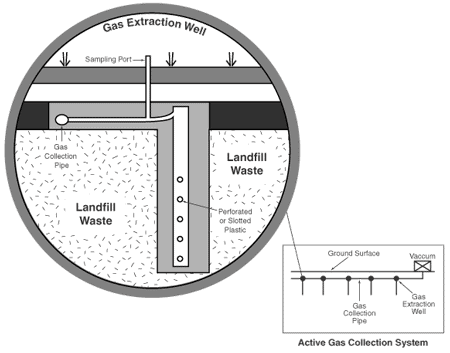
The landfill-to-energy process begins with garbage collected and brought to landfill operations. Much of it is organic and is broken down by bacteria in a natural process. Methane and other gasses known as landfill gas is produced. With special wells the gas is captured and piped to a processing facility.
After processing it is the same as natural gas and can be used the same way.


Each landfill gas "well" is just a couple pipes drilled into the ground.


Waste Management Partnering to Find Gas in the Trash: This project at the Altamont Landfill is only one of many which Waste Management plans to launch. They own 477 landfills and have announced intent to open 60 landfill gas projects by the end of 2012. Further there are 1,700 operating landfills in the U.S., and according to the the EPA’s Landfill Methane Outreach Program, they contain enough natural gas to produce 2,643 megawatts of electricity.

CARB tables of landfill gas composition shows the percentages of different constituents to landfill gas. On average it's 44% methane and 35% CO2, both are recognized as the leading components to greenhouse gas.

Clearly averting the emission of those gasses into the atmosphere would abate some greenhouse gas issues. However burning the landfill gas doesn't destroy the carbon. Therefore burning landfill gas cannot avert emission of the landfill gas. What it can do is replace the use of some fossil natural gas or fossil liquid fuels.


Production of 25 MW of Electricity Using Landfill Gas: Describes a project in Montreal (Canada) to build an electricity plant that uses landfill gas as its fuel. The plant cost CAD $37 million to build and produces 25 megawatts of power.

Video: Powering Up with Landfill Gas: Discusses a similar project at the University of New Hampshire. In the video it's mentioned they've been "flaring" their landfill gas, and are now instead using it to generate power. Flaring gas just means they're burning it with no attempt to capture any energy. Turning it from a flaring to power production situation is an improvement by any measure.

Waste-based Renewable Energy: Landfill operators place collection wells that act like straws throughout a landfill to draw out the methane gas. The gas is then piped to a compression and filtering unit beside the landfill. Technicians make sure that the gas is filtered properly before it is piped to its end user. The entire process is carefully managed to prevent odors and leakage of waste material.

California Energy Commission, Renewable Energy Research, Biomass and Landfill is a resource center about landfill gas research in California. When a landfill is capped, landfill gas (LFG) is generated as organic portions of the municipal solid wastes (MSW) are decomposed. Traditionally, landfill is not controlled and the expected period over which landfill gas will be produced may range from 50 to 100 years. But a usable landfill gas production rate that can be utilized lasts for only 10 to 15 years. A bioreactor is a controlled landfill in which water and other nutrient sources are added into the MSW to increase the landfill gas production rate.

The four basic uses of landfill gas is:
  1. medium-BTU gas production, 
  2. electricity generation, 
  3. injection into existing natural gas pipelines, 
  4. conversion to other chemical forms. California leads the nation in both the solid waste generation and number of landfill gas to electricity (LFGTE) facilities. The Puente Hills landfill, operated by the Los Angeles County Sanitation District, produces approximately 46.5 MW of power and is the largest LFGTE facility in the U.S.

US EPA Landfill Methane Outreach Program (LMOP): is a voluntary assistance and partnership program that promotes the use of landfill gas as a renewable, green energy source. Landfill gas is the natural by-product of the decomposition of solid waste in landfills and is comprised primarily of carbon dioxide and methane. By preventing emissions of methane (a powerful greenhouse gas) through the development of landfill gas energy projects, LMOP helps businesses, states, energy providers, and communities protect the environment and build a sustainable future.

Instead of allowing LFG to escape into the air, it can be captured, converted, and used as an energy source. Using LFG helps to reduce odors and other hazards associated with LFG emissions, and it helps prevent methane from migrating into the atmosphere and contributing to local smog and global climate change.

Is Landfill Gas Green Energy? Is a study by the Natural Resources Defense Council looking at just how "green" an energy can one get from landfill gas.
  • Combustion of raw LFG in a flare, an engine, or a turbine dramatically reduces the overall toxicity.
  • Collection and combustion dramatically reduces global warming impacts and toxicity.
  • Using LFG to generate electricity further reduces the greenhouse gas impacts and also reduces emissions of nitrogen oxides, sulfur dioxide and mercury. Burying garbage in landfills results in the release of more heat-trapping gases than any other waste-management option.
  • Because LFG is a by-product of landfills, and landfills are such a poor way to manage our waste, LFG can not be considered renewable.
An Overview of Landfill Gas Energy in the United States: Methane as GHG is over 20x more potent by weight than CO2.

Linde and Waste Management commission world’s largest landfill to liquefied natural gas facility

Altamont Landfill's gas fuels garbage trucks

World’s Largest Landfill Gas to LNG Plant Opens in California:

Landfill waste to power Waste Management hauling fleet

Landfill Gas to Energy

http://en.wikipedia.org/wiki/Biogas


Renewables and Alternate Fuels > Landfill Gas

Baltimore Landfill Gas Powers Up Coast Guard Yard

Production of Renewable Energy

Landfill Gas Resources and Technologies

Energy Companies To Harvest Durham Landfill Gas

Mexico’s President Applauds Monterrey’s Landfill Gas Plant as Model Renewable Energy Project for Latin America

Duke Energy Carolinas Signs Deal to Turn Landfill Gas into Energy

Waste Management to build 60 new landfill gas plants

LANDFILL GAS-TO-ENERGY PROJECT CASE STUDIES

Landfill gas–to–energy facility at Cedar Hills Regional Landfill

Landfill Gas Videos

allvoices

Friday, June 19, 2009

Grid Alternatives

Description: 

GRID Alternatives’ mission is to empower communities in need by providing renewable energy and energy efficiency services, equipment and training. Since 2001, GRID Alternatives has been working to bring the power of solar electricity and energy efficiency to low-income homeowners, and to provide community members with training and hands-on experience with renewable energy technologies. We believe making energy choices that are good for the environment can go hand-in-hand with improving the lives of those living in low-income communities.

GRID Alternatives works collaboratively with communities and local organizations to identify specific needs and to develop renewable energy solutions that are environmentally, socially and economically sustainable. Our vision of sustainable development centers on community involvement, and our focus and expertise lies in using renewable energy and energy efficiency to provide solutions to the challenges facing low-income individuals and families. We have offices in the San Francisco Bay Area, Greater Los Angeles, and San Diego to serve communities throughout California.


allvoices

Friday, April 24, 2009

The Energy Dude

Description: 

A dude working on alternate energy of some kind. It's not real clear from the website what the heck he's doing.

extvideo: 

allvoices

Monday, November 24, 2008

Alternative Fuels Institute

Description: 

Serves the public by providing education services, by providing an agency for funded and educational research in the area of E85 and alternative fuels and by providing a resource and service function for grassroots Americans across the nation. The AFI is organized and shall be organized exclusively for benevolent, charitable, civic, cultural and educational purposes. Its specific purpose is to promote public education of alternative fuels, including but not limited to ethanol and E85.

extvideo: 

allvoices

A Global Overview of Renewable Energy Sources

Description: 

The AGORES site is designed to be a most extensive global international information centre and knowledge gateway for Renewable Energies. Originally it was built for the European Commission, but over the last few years, our site has been extended to the whole world's information on Renewable Energy.

extvideo: 

allvoices