Showing posts with label Renewable Energy. Show all posts

Thursday, April 25, 2013

Breaking: North Carolina ALEC-Modeled Bill To Repeal Clean Energy Standard Fails In Committee

North Carolina's renewable energy industry is safe from legislative threats, for now. Republicans and Democrats in the sponsor's own committee voted down his bill that would have repealed the state's clean energy standard. This bill mimicked "model legislation" from the American Legislative Exchange Council (ALEC).

WRAL NC Capitol reports:

[Bill sponsor] Rep. Mike Hager, R-Rutherford, had pulled House Bill 298 from the House Committee on Environment, where it faced questionable support, to put it in front of the House Committee on Public Utilities and Energy, which he chairs, in hopes of keeping the legislation moving forward.

Instead, an 18-13 vote killed the bill, with powerful Republican Reps. Tim Moore, Ruth Samuelson, Nelson Dollar and others joining Democrats in opposing the measure.

Rep. Hager used to work for Duke Energy, and is a member of ALEC, a right-wing state legislation factory that has received funding from the Koch brothers and the Heartland Institute. The Kochs also donated to the John Locke Foundation, founded by Art Pope. Pope, not a fan of renewable energy, was very active in the 2010 state elections, spending $2.2 million to elect a Tea Party-fueled GOP takeover of the state legislature.

Passed in 2007 with bipartisan support, the state's renewable energy standard required utilities to use increasing amounts of renewable energy. The clean energy industry has since created thousands of North Carolina jobs and pumped billions into the economy. North Carolina was the first state in the Southeast to achieve a renewable energy standard. It is not just solar panel and wind turbines that support the bill. Prestige Farms is a turkey and pork processor, and opposed Hager's bill because it would jeopardize the construction of a waste-to-energy plant in eastern North Carolina.

Hager's own committee did reject his bill 18-13, yet the bill is technically still alive. Hager could try to make changes to the bill to revive it, though those changes would have to be significant.

Below the fold is an infographic on the renewable energy industry in North Carolina, which explains why the RES is so important:

Update

The Charlotte News & Observer reports on why key Republicans voted to repeal Hager's bill: "Those who voted against it said the program had added jobs in their districts and recruited businesses to the state during a severe economic downturn. Since its adoption in 2007, the state's renewables policy has turned North Carolina in the nation's fifth-largest developer of solar energy. 'It was based off local issues back home,' said Rep. Tim Moore of Cleveland County, who also chairs the powerful House Rules Committee. 'I would have had a difficult time talking to a CEO who just brought 300 jobs to Cleveland County that I'm going to vote to eliminate this program that justified their investment.'"


http://thinkprogress.org/climate/2013/04/24/1915831/breaking-north-car


allvoices

Wednesday, March 20, 2013

Maryland Governor Poised To Sign Bill Incentivizing Offshore Wind Power

Maryland Governor Martin O'Malley

By Howard Marano and Michael Conathan

For the moment at least, the U.S. offshore wind industry has a new capital: Annapolis. By an 88 to 48 vote, the Maryland House of delegates handed Governor Martin O'Malley one of his most desired legislative victories - enactment of a bill that would earmark $1.7 billion for development of a wind farm in federal waters off Maryland's coast, with the funding coming from up to a $1.50 monthly surcharge on consumers' electricity bills. The bill, which passed the Senate earlier this month now heads to the Governor's desk for signature into law.

The Maryland Offshore Wind Energy Act of 2013 has been one of O'Malley's top goals for years, as he's sought to take advantage of Maryland's expanse of shallow water, its "outstanding" wind resources, and its existing industrial infrastructure - all of which make Maryland an ideal place for offshore wind.

Despite these prime features, development of offshore wind in Maryland, as in the rest of the country, has been a long time coming. In two previous legislative sessions O'Malley attempted unsuccessfully to shepherd his bill though the legislature, demonstrating the political hurdles standing in the way of development even in an environmentally friendly state. At first, opponents were able to torpedo the bill due to its cost. Then when proponents lowered the price cap to $1.50 in 2012, political wrangling sunk the bill as the clock expired on the legislative session.

Since O'Malley's bill was first introduced in Maryland, the American onshore wind industry has seen tremendous growth. In fact, with the installation of 13,000 megawatts of new capacity, 2012 was a banner year for wind in the U.S. In contrast, not a single wind turbine has been installed off America's coasts in that time. While the offshore wind industry in the U.S. has struggled to overcome financial, political, and bureaucratic hurdles, offshore wind in Europe and Asia has continued to expand. Maryland's Offshore Wind Energy Act is meant to help reverse that trend.

Like its predecessors, the current bill would require that, within Maryland's renewable energy portfolio standard program, a certain percentage of electricity be supplied by offshore wind starting in 2017. In order to protect consumers from excessive rate increases resulting from the higher costs of wind energy production, the bill creates a "window of maximum rate impacts for both residential and nonresidential electric customers." Currently, this would amount to $1.50 per month for a household and a monthly surcharge of 1.5 percent for businesses. The new law is the first of its kind requiring direct subsidies from ratepayers, and was made politically palatable by a 2013 poll showing 72 percent of Maryland residents would be willing to pay $2 more per month for their electricity bills to develop an offshore wind industry.

The benefits of offshore wind in Maryland would still be substantial. The Governor's office estimates the project would create 850 construction jobs and 160 supply and operation and maintenance jobs. According to an analysis completed by the Maryland Department of Business and Economic Development, a 200 megawatt project would create $1.3 billion in economic activity over a five year period, generating $5.6 million in state tax revenue. And data from the National Academy of Sciences suggests Maryland stands to gain $17 million in annual public health benefits as a result of reduced fossil fuel use for electricity production.

The return on investment from any first-in-class offshore wind project will be just the tip of the iceberg. The Center for American Progress released a report in February detailing the overall benefits of developing a commercial scale offshore wind industry in the U.S. The report found that the investment required to develop an offshore wind industry would be far less than the federal government has spent on subsidizing fossil fuel industries, and that the cost to ratepayers could be as low as $0.25 per month.

While passage of the Maryland Offshore Wind Energy Act represents a victory for advocates of offshore wind, substantial obstacles still remain. Concessions made to secure the bill's passage have caused industry analysts to warn that any project will be reliant on additional tax incentives to become profitable. Even Governor O'Malley has recognized this concern at a press conference, saying "I don't believe any one state can do this by itself."

Fortunately, Maryland won't have to act on its own. Under President Obama, the Department of Energy has prioritized offshore wind, pursuing its "Smart from the Start" program that has already identified wind energy areas off the coasts of several northeast and mid-Atlantic states. And just last week, the Bureau of Ocean Energy Management announced the latest step in granting the Commonwealth of Virgina a research lease for a wind energy area off its coast. Even Congress has gotten into the act, passing a one-year extension of key tax credits that move the industry a step closer to offshore wind production.

From Denmark to China, other countries have already realized the benefits of generating electricity from strong, consistent offshore winds and revitalizing sagging coastal economies. O'Malley's legislation is an excellent step forward on both counts for his state and for the country.

Howard Marano is an intern with the Ocean Program and Michael Conathan is Director of Ocean Policy at the Center for American Progress.


http://thinkprogress.org/climate/2013/03/20/1749381/maryland-governor-


allvoices

Clean Energy Trends: The Future Is All About Deployment

By Ron Pernick

2012 proved to be an unsettling and difficult year for clean energy. High-profile bankruptcies and layoffs plagued many clean-tech companies, overall venture investments retreated in the face of increasingly elusive returns, and the industry was begrudgingly transformed into a partisan wedge issue during the U.S. presidential campaign.

But as we highlight in our just-released Clean Energy Trends 2013 report, the fundamental global market drivers for clean technology remain largely intact. Intensifying resource constraints loom large. Unprecedented climate disruption in the U.S. and abroad is putting resiliency and adaptation front and center. And President Obama has signaled a strong commitment to expanding clean energy and energy efficiency in his second term, calling for another doubling of renewable power by 2020. Similar commitments exist in China, Japan, and the European Union.

The report found that lower prices for many clean-tech goods and services, combined with a renewed focus on scalable projects, resulted once again in record annual solar, wind, and biofuels deployment. Against this continued expansion, however, combined global revenue for solar PV, wind power, and biofuels expanded just one percent, from $246.1 billion in 2011 to $248.7 billion in 2012. This marginal growth was one of the many consequences of rapidly declining solar PV prices.

Some of the report's key findings include:

  • Biofuels (global production and wholesale pricing of ethanol and biodiesel) reached $95 billion in 2012, up from $83 billion the previous year. From 2011 to 2012, global biofuels production expanded from 27.9 billion gallons to 31.4 billion gallons of ethanol and biodiesel.
  • Wind power (new installation capital costs) expanded to $73.7 billion in 2012, up from $71.5 billion the previous year. Global wind capacity additions totaled 44.7 GW (gigawatts) in 2012, a record year led by more than 13 GW added in both China and the U.S., and an additional 12.4 GW of new capacity in Europe.
  • Solar photovoltaics (including modules, system components, and installation) decreased from a record $91.6 billion in 2011 to $79.7 billion in 2012 as continued growth in annual capacity additions was not enough to offset falling PV prices. While total market revenues fell 19 percent - the first PV market contraction in Clean Energy Trends' 12-year history - global installations expanded to a record of 30.9 GW in 2012, up from 29.6 GW the prior year.
  • Together, we project these three sectors will continue to grow over the next decade, nearly doubling from $248.7 billion in 2012 to $426.1 billion in 2022.

Ôøº

In many ways the shift to cleaner sources couldn't be clearer. Renewables and natural gas made up more than 80 percent of new electricity capacity additions in the U.S. in 2012, with renewables coming in at 49 percent and natural gas at 33 percent. For the European Union, the renewables number is even higher, with solar in the driver's seat. In 2012, newly installed solar PV accounted for 37 percent of all added capacity, followed by wind with a 26.5 percent share, and gas at 23 percent. In total, renewable sources represented more than 31 GW of the 44.6 GW of new generation capacity in the EU, roughly 70 percent of all new capacity for the second consecutive year.

Generating capacity is, of course, not the same as actual generation. But even in this regard, clean energy sources have moved past their days as rounding errors and are playing a significant role in meeting electricity demand in a number of global markets. Wind energy in Denmark blew past a 30 percent share of national electricity use in 2012, and an official target is in place to generate half of the nation's power from wind by 2020. In Germany, clean energy already accounts for 25 percent of energy production - led by wind (9.2 percent), biomass (5.7 percent), and solar (5.3 percent) - and the country is aiming for 35 percent from renewables by 2020.

Clean energy continues to expand as a major economic force, with an increasing focus on deployment of readily available technologies.

In early 2013, for example, Warren Buffett's MidAmerican Energy Holdings expanded its solar portfolio with a whopping $2 billion acquisition of the Antelope Valley Solar Projects in Southern California, one of the largest utility-scale solar developments in the world. (Buffett's investment in the Antelope projects came with long-term purchase agreements already lined up with Southern California Edison.) Google's recent $200 million equity investment in a Texas wind farm pushed the tech giant's ownership in solar and wind projects to a combined 2 GW, making it one of the largest renewable energy asset owners. And in January, car rental giant Avis Budget Group announced its plan to buy car-sharing pioneer ZipCar for $500 million, a promising reminder that new ways of thinking can be just as disruptive as new technologies.

What all this seems to point to is something we've talked about for years: the scale-up of clean-tech deployment. And it's not just the big investors shifting their focus toward deployment. Mosaic, which we highlight in this year's Trends report, is bringing solar deployment investment opportunities to small investors via a crowdfunding platform, offering annual yields of around 4 to 5 percent. And don't forget the state-level Green Banks established in Connecticut and announced in places like New York and Hawaii or the prospects for new project deployment tools like real estate investment trusts (REITs) or master limited partnerships (MLPs).

Indeed, the near- to mid-term will be all about getting assets in the ground. That is where the action will be. It will take many shapes and sizes, from large corporate investments to crowdfunding and will span the globe from the U.S. to Japan.

This new focus on deployable and proven technologies reflects the maturation of an industry that was a mere blip on the economic radar just a decade ago, but today represents the largest slice of new electricity capacity additions in the U.S. and European Union. Even in pro-nuclear China, wind overtook the atom as a generator of electricity in that nation's power mix in 2012. To ensure that clean energy keeps up its momentum, however, we'll need new models and a leveling of the playing field - and that will take hard work, creativity, and, in the face of entrenched interests, a great deal of steadfast commitment and endurance.

Ron Pernick is founder and managing director of research and advisory firm Clean Edge and the coauthor of two books on clean-tech business trends and innovation, Clean Tech Nation (HarperCollins, 2012) and The Clean Tech Revolution (HarperCollins, 2007).


http://thinkprogress.org/climate/2013/03/20/1746431/clean-energy-trend


allvoices

Friday, March 1, 2013

Kansas Legislature Rejects Koch-Backed Effort To Chip Away At Renewable Energy Standards

The Topeka Capital-Journal reports that twin votes in Kansas State House and Senate on Thursday put the kibosh on legislative efforts to roll back and delay Kansas' renewable energy standard (RES).

Passed in 2009, Kansas' RES requires investor-owned utilities to generate 20 percent of peak demand electrical capacity from renewable sources by 2020. The American Wind Energy Association has actually highlighted the RES as a driving factor in the states burgeoning wind power sector - half of Kansas' wind farms began operating between 2010 and 2012, after the RES went into effect.

Unfortunately, Kansas has also been targeted by conservative anti-renewable efforts. Republican Rep. Dennis Hedke, the chairman of Kansas' House Energy and Environment Committee, recently acknowledged he had private talks with a lobbyist for Koch Companies Public Sector LLC concerning the House bill to dilute the RES. (HB 2241) Even anti-tax activist Graver Norquist got in on the action, telling the state's legislature it ought to abandon the "costly renewable energy mandate so as to mitigate its negative impact on the economy."

But to Kansas' credit, it looks like neither effort bore fruit:

[T]he Senate responded by voting 17-23 to defeat Senate Bill 82 that would have postponed the deadline for complying with the Kansas renewable portfolio standard. Instead of Kansas utilities reaching 15 percent of power from wind, solar or other alternative source in 2016, the bill would have moved the date to 2018. The measure also pushed the 20 percent mandate to 2024 from 2020. [...]

The House answered by voting 63-59 to send House Bill 2241 back to a committee for additional deliberation. This measure would amend the state's portfolio standard to declare 15 percent must be met by 2018, but the 20 percent target would be dropped.

House Republicans and Democrats supportive of the motion said previous House committee work on the bill was flawed, while other representatives questioned the goal of rewriting the state's renewable energy standard because the amendment would remove "regulatory certainty" for business.

"I would suggest we exercise prudent restraint," said Rep. Russell Jennings, R-Lakin. "In fairness to business, and in fairness to the people of Kansas, they need some certainty."

Kansas is one of many states in which organizations like The Heartland Institute and the American Legislative Exchange Council have been lobbying against renewable energy policy, and pushing "model legislation" to undo renewable standards - part of a broader shift by conservative organizations recently to attack clean energy efforts at the state level.

Nor is renewable energy the only policy area in which conservatives and climate change skeptics have tried to convince Kansas to set back its own advancement - often with the aforementioned Rep. Hedke, a contract geophysicist with a client list that includes 30 regional oil and gas companies, at the lead. Earlier this year, Hedke introduced a bill, HB 2366, that would prohibit public funds from being used "either directly or indirectly, to promote, support, mandate, require, order, incentivize, advocate, plan for, participate in or implement sustainable development." Another Kansas House committee recently put forward a law - likely the product of ALEC's "model legislation" - requiring the state's educators to teach students "evidence which both supports and counters" the science of climate change.

In all these cases, Kansas would be wise to continue pushing back right-wing efforts while moving ahead with clean energy policy. Kansas is one of the Plains states that's been wracked by record-breaking droughts over the last few years, likely driven by global warming, as well as other forms of economically damaging extreme weather.


http://thinkprogress.org/climate/2013/03/01/1660201/kansas-kills-koch-


allvoices

Friday, January 25, 2013

New 'Rock Candy' Process To Manufacture Silicon Could Make Solar Power Even Cheaper

By Tina Casey Via Clean Technica

Researchers at the University of Michigan have come up with a low-cost way to manufacture high-grade silicon, based on a concept familiar to anyone who has tried to make rock candy at home. If the breakthrough can be translated into a commercially viable process, it would make ultra-cheap solar tech like V3Solar's Spin Cell (which we were just raving about the other day) even cheaper.

Ironically, funding for the research project came from the American Chemical Society Petroleum Research Fund, but maybe they know something we don't.

Cooking Up a Batch of Low-Cost Silicon

Silicon is the key component of conventional solar cells. It comes from silicon dioxide, aka sand, which is one of the cheapest and most abundant materials on Earth, but converting sand into high grade silicon is a high cost, energy intensive process with a pretty significant carbon footprint.

As described by U of Mich writer Kate McAlpine, the new process works at just 180 degrees Fahrenheit, which is a far cry from the 2,000 degrees needed for conventional silicon manufacturing.

The method basically consists of covering a liquid gallium electrode (gallium is a soft whitish metal that has a melting point around room temperature) with a layer of a solution based on silicon tetrachloride (a colorless, flammable liquid).

As in conventional silicon processing, electrons from the metal convert the silicon tetrachloride into raw silicon. The new twist is that by using soft metal with a low melting point, the research team was able to get the raw silicon to form crystals without exposing the solution to additional heat.

A Ways to Go for Low Cost Silicon

The team has observed films of silicon crystals forming on the liquid gallium electrodes, but so far the individual crystals are only about 1/2000th (yes that's 1/2000th) of a millimeter in diameter.

There is still a long way to go before the process jumps from the lab into commercial viability, and the next steps include experimenting with other metal alloys that have low melting points.

Meanwhile, other routes to low-cost silicon based solar power are at or near commercial development, and they could go even lower if the U Mich research pans out.

One approach, illustrated by the aforementioned V3Solar Spin Cell (which by the way began life as Solarphasec), is to squeeze more power out of conventional solar cells by reconfiguring the solar module.

The Spin Cell reboots the typical flat solar panel into a 3-D cone. Along similar lines, MIT researchers have come up with a solar "tower of power" that takes advantage of 3-D angles.

The 3-D concept can also be internalized, as demonstrated by a company called (what else) Solar3D.

On a completely different note, the Obama Administration is also focusing on lowering the "soft costs" of solar power, which typically account for half the cost of a completed solar installation.

The Petroleum Research Fund

Well, here's hoping. In any case, the really interesting part of the story is the involvement of the Petroleum Research Fund, which states at the top of its home page that its mission is to support "fundamental research directly related to petroleum or fossil fuels."

In its vision statement following that declaration, the Fund waxes a little more expansive, describing itself as dedicated to "significantly increasing the world's energy options," though directly after the following note appears: "Proposals will no longer be considered in solar power, which includes photovoltaics and solar cells."

Apparently the U Mich project got in under the wire, but it shouldn't be surprising that a grant-making organization with roots in the petroleum industry was at least once open to solar power research.

Solar power has long been used as an economical way to provide energy to remote oil fields, where grid connections would be difficult if not impossible.

Given the energy intensity of harvesting unconventional oil, most notably from Canada's tar sands, low-cost power in any form would be a welcome development for the petroleum industry.

- Tina Casey, reprinted from Clean Technica with permission


http://thinkprogress.org/climate/2013/01/25/1497561/new-rock-candy-pro


allvoices

Tuesday, January 22, 2013

Wind Beats Out Natural Gas To Become Top Source Of New Electricity Capacity For 2012

Through June of 2012, renewable energy was right behind natural gas in terms of the most new energy generating capacity being installed in the United States, with wind making up most of the renewables push. And now Business Insider has flagged the numbers for the remainder of the year.

Last week, they reported that wind ultimately pulled ahead of natural gas to become the leading installer of new capacity in 2012, at 10,689 total megawatts.

Those numbers came from the Federal Energy Regulatory Commission's report on the trends and highlights in U.S. energy for the past year. According to FERC's update, natural gas installed 8,746 megawatts of new capacity, coal installed 4,510 new megawatts, and solar came in fourth with 1,476 new megawatts. Here's the relevant table from the report, conveniently highlighted by Business Insider:

One thing to note here is the issue of capacity factor: That's how much power an installation actually produces as a percentage of its theoretical capacity. (Which is what's listed in the table.) Natural gas plants do quite well in this regard: Their median performance tends to come out to at least 80 percent, and they max out at 93 percent, according to the National Renewable Energy Laboratory's cost database.

Unfortunately, wind power doesn't perform as well, due to the intermittency of, well, wind. Its median tends to be around 40 percent offshore. Onshore it's been at 30 percent, though arguably onshore performance is pulling alongside offshore. And both max out at 50 to 54 percent. So even though wind beat out natural gas for new capacity in 2012, the new natural gas installation will almost certainly wind up generating more total electricity.

The good news for wind is that it's still a relatively young technology, with lots of room to improve. The energy it does deliver is produced much more efficiently in comparison to natural gas - the former loses less than one percent of its energy as waste heat, while the latter can lose as much as 54 percent. Natural gas production in the U.S. may be on track to plateau, leading to predictions of rising prices, which will give wind power a further economic opening.

And, of course, there's the fact that, while cleaner than coal, natural gas remains a contributor to greenhouse gas emissions both through leaks and combustion.


http://thinkprogress.org/climate/2013/01/22/1479961/wind-beats-out-nat


allvoices

Thursday, October 13, 2011

GE Enables Mississippi’s First Landfill Gas-to-Electricity Project to Support Region’s Grid


  • Golden Triangle Regional Landfill Project Reduces Greenhouse Gas Emissions, Creates New Revenue Source to Help Lower Landfill Costs for Businesses, Residents
  • GE’s Jenbacher Gas Engines Enable Landfill Operators, Utilities and Others to Produce Cleaner, More Reliable Power
  • Milestone Landfill Gas Project Highlights Public-Private Partnership Efforts to Tackle the Country’s Third-Largest Human Source of Methane Emissions

STARKVILLE, Miss.--  With Mississippi looking to produce more domestic energy from renewable resources, government officials, utility and GE (NYSE: GE) representatives gathered today at the Golden Triangle Regional Landfill in northeastern Mississippi to mark the commercial start-up of the state’s first landfill gas-to-electricity (LFGTE) project that will support the regional grid.

Owned by the Golden Triangle Regional Solid Waste Management Authority (GTRSWMA), the LFGTE facility uses an ecomagination-qualified, GE J320 Jenbacher landfill gas engine (http://ge-j920gasengine.com/) to generate nearly 1 megawatt (MW) of renewable power sold through Tennessee Valley Authority's (TVA) renewable power initiative—enough to support about 700 average U.S. homes. The engine generates this power by using methane gas from solid waste decomposition, which would have otherwise been wasted by being released into the atmosphere as a pollutant and potent greenhouse gas, as a valuable renewable fuel. Methane has a global warming factor 21 times greater than carbon dioxide, the most widely recognized greenhouse gas affecting climate change.

In September, Mississippi Gov. Haley Barbour toured the Golden Triangle facility and praised the project for supporting the state’s energy and economic priorities.

"Mississippi’s energy policy is simple: produce more affordable, abundant American energy," Gov. Barbour said. "This project at the Golden Triangle Regional Landfill fits in well with our state's strategy to have diverse energy resources to support our long-term economic growth."

Officials attending Tuesday’s opening of the landfill gas power plant echoed the governor’s comments.

“We are excited to serve as a model for the development of innovative landfill gas-to-electricity projects to help Mississippi diversify its energy resources and improve the environment,” said Jimmy Sloan, executive director for GTRSWMA. “Our project also will provide an important new revenue stream that we will use to help keep our landfill fees as low as possible for area residents and businesses in these challenging economic times,” Sloan added.

The TVA is purchasing the power from the 4-County Electric Power Association distribution system under the auspices of the TVA‘s Generation Partners program, which supports the production of renewable energy within the utility’s coverage area. The energy and associated positive environmental benefits are purchased through the program, which then transfers the right to claim the renewable attributes to Green Power Switch® customers.

The Golden Triangle site is the state of Mississippi’s first LFGTE project developed to support the regional grid, according to U.S. Environmental Protection Agency’s Landfill Methane Outreach Program (LMOP) database. According to LMOP, there are more than 558 LFTGE projects throughout the United States that are producing a total of 1,727 MW.

These numbers are compelling, given that landfills are the third-largest, human-generated source of methane emissions in the United States, releasing an estimated 27.5 million metric tons of carbon equivalent to the atmosphere in 2009 alone.

Developing more projects like the one at Golden Triangle Landfill will be crucial as the country works to produce cleaner energy and reduce industrial sources of environmental impact. One J320 landfill gas engine is designed to generate almost 8,000 MWh of electricity per year, which would require more than 2 million cubic meters of natural gas for generation in an average U.S. natural gas-fired power plant.

“Golden Triangle is taking a leading role in showing how municipalities can capture a landfill’s waste gas that would have created more environmental impact and instead recycle it into valuable fuel for renewable energy,” said Roger George, North American regional sales leader—Gas Engines for GE Energy. “This not only results in a cleaner environment but also offers clear economic benefits for surrounding communities.”

George noted that while most of the landfills in the northeastern and western United States are developed, a significant amount of waste continues to be transported from high-population areas to rural regions, making the southeastern United States the fastest growing region for new LFGTE projects.

In addition to supplying the Jenbacher gas engine, GE also brought the TVA’s Generation Partners renewable energy purchase program to the attention of the GTRSWMA’s landfill board. Nixon Energy Solutions, GE’s Jenbacher gas engine authorized distributor in Mississippi, delivered the unit to the site before it was installed by SCS Field Services.

GE’s alternative gas-to-power portfolio includes Jenbacher and Waukesha gas engines and is specifically designed for fuel flexibility needed to accommodate the use of alternative fuels such as landfill gas, while offering high levels of electrical efficiency. GE’s Jenbacher landfill gas engines are qualified under ecomagination, GE’s commitment to invest in a future that creates innovative solutions to global environmental challenges. Overall, the Gas Engines business has more than 1,650 units operating on landfill, with an electrical output of over 1,650 MW.

About GE

GE (NYSE: GE) is an advanced technology, services and finance company taking on the world’s toughest challenges. Dedicated to innovation in energy, health, transportation and infrastructure, GE operates in more than 100 countries and employs about 300,000 people worldwide. For more information, visit the company's Web site at www.ge.com.

GE also serves the energy sector by providing technology and service solutions that are based on a commitment to quality and innovation. The company continues to invest in new technology solutions and grow through strategic acquisitions to strengthen its local presence and better serve customers around the world. The businesses that comprise GE Energy—GE Power & Water, GE Energy Management and GE Oil & Gas—work together with more than 100,000 global employees and 2010 revenues of $38 billion, to provide integrated product and service solutions in all areas of the energy industry including coal, oil, natural gas and nuclear energy; renewable resources such as water, wind, solar and biogas; as well as other alternative fuels and new grid modernization technologies to meet 21st century energy needs.

Contacts

GE Gas EnginesAnja Pegger, +43 5244 600 2337 anja.pegger@ge.com or

Masto Public Relations Gina DeRossi or

Howard Masto +1 518-786-6488 gina.derossi@mastopr.com howard.masto@ge.com


allvoices

Tuesday, February 22, 2011

How the Western US can implement large-scale implementation of wind and solar power

Most of us desire a clean environment, and desire electricity to be generated with no negative consequence. As it stands electricity generation has huge negative consequences from the coal emissions, to the mining operations to get the coal, to disposing of the coal residues, and the CO2 etc emitted from burning natural gas. It's a bad story that can be fixed through using more wind and solar energy. But wind and solar needs some sort of energy storage to balance out variability and the troughs in production.

Debra Lew, of the National Renewable Energy Laboratory, gave a presentation at the Energy Seminar at Stanford University discussing models for how the Western US could adopt large quantities of wind and solar energy. One conclusion they came to is that large scale energy storage systems aren't as necessary as conventional wisdom would believe.

Wind power - mostly occurs at night - Solar power - mostly occurs during the day. Hence the simple assumption is you need to store energy from when generation is at its peak production and release stored energy when it's in a trough. That is, next to the wind farm you install an energy storage system that fills up overnight, and releases energy during the day.

However.. Ms. Lew says this isn't necessary, if the grid operators make some changes to how the business is run.

Observation: Wind and solar energy complement each other. One has its peak when the other is in a trough. Hence energy storage isn't required so much as having enough generating capacity. A factoid about energy storage systems is they're currently rather expensive. The grid operators will want to minimize energy storage systems, and the cheapest way to do so is to not buy it but instead by enough wind/solar generating capacity so that one system makes up for the other system's trough.

The Western US is covered by WECC which is an electrical interconnect zone. In most of WECC there is little cooperation between the utilities, leaving each utility on its own to balance its load.

Ms. Lew gives regional "balancing area cooperation" as a primary change to implement for renewable energy to make a big impact in the West. For example Wyoming has huge wind resources, and could be supplying electricity to the rest of the West if only there were enough cooperation and transmission lines.

She gave a bunch of other recommendations. The whole pile of them boiled down to: greater flexibility

Their study shows it's operationally feasible for the Western US to adopt Wind and Solar at a large scale.

She did say that historically this region has tried to set up more cooperation but ran into political problems. Essentially the individual utilities have resistance to their autonomy being undermined by a regional cooperative. But she went on to say that as they get more experience with renewable energy they'll realize regional cooperation is vital.


allvoices

Tuesday, January 19, 2010

An Electric 'Game Changer' Gets FERC Scrutiny

A proposal to move large amounts of wind and solar power out of the Southwest by linking the three separate North American electricity grids with state-of-the-art switching terminals and superconducting cables is now in hands of federal regulators.

Tres Amigas LLC has petitioned the Federal Energy Regulatory Commission for two key rulings ...

...The three terminals would receive alternating-current power from transmission companies in Texas, New Mexico and Oklahoma, and convert it to direct-current flows using solid-state voltage source converters. The direct current would move between the three terminals to carry out any of six possible transactions: Power could flow into or out of Texas, for instance by way of the two interconnections, or it could move between the interconnections directly.

The use of direct current and voltage converters will overcome the current barrier to power transfers between Texas and the interconnections, each of which is operating out of sync electrically with the other, a condition that would destroy equipment if an alternating-current connection were made today....

...Harris said in an interview that he purposely did not seek Energy Department stimulus grants for the new technology and proclaimed confidence that the project can be privately financed through debt and equity investments....

Transmission providers can use the Tres Amigas connection to buy the cheaper power in one grid for sale in a higher-priced region, and Tres Amigas will profit by moving the energy, the firm's FERC filing says.

FERC's approval of Tres Amigas' flexible pricing proposal is essential, says Raskin. "To maximize the value of this facility, we need to have a combination of long-term and short-term pricing authority. We are pushing FERC's precedents."...

The Tres Amigas petition to FERC says that because energy is converted from an AC wave to a DC electronic pulse and then back into an AC wave synchronized with the receiving grid, the electrons in Texas are not "free flowing" into New Mexico or Oklahoma, preserving Texas' separation....

The Tres Amigas project stands to make an interesting and vital contribution to the state of renewable electricity production in the U.S. (see Tres Amigas Project in New Mexico promises more renewable energy through better electrical grid connectivity for more information) The south-west and especially west-texas regions have a lot of solar and wind power. The texas panhandle region has an especially strong wind resource. Further the regions are lightly populated. This makes them attractive for building wind and solar power installations but the problem is how to get power produced in those facilities to the market.

It turns out the U.S. electric market has three power regions. They are the Eastern Interconnection east of the Rocky Mountains, the Western Electricity Coordinating Council (WECC) west of the Rockies, and the Electric Reliability Council of Texas (ERCOT). Further the Texas statewide grid that Texas is a jurisdictional thing maintained by Texas to prevent federal regulation of its utility industry. This is a remnant of Texas's past as an independent nation which chose on its own to join the United States.

The Tres Amigas project creates an interchange between the three regions so that power can be sold between the regions. Hence electric production facilities can be built in, for example, the Texas Panhandle area and then sell power to the rest of the country. If there were no power sale agreement or interconnect then a producer in the Texas Panhandle could produce all the electricity they want but could only sell it to Texas.

As explained in the linked NY Times article the project has to jump through a few hoops to retain Texas' status as having its own electric power grid that isn't subject to federal regulation. It converts the alternating current electricity used on the grid into direct current electricity for exchange in the Tres Amigas interconnect facility. By doing the AC-DC-AC conversion they avoid a "direct flow" of electricity keeping FERC's grubby hands off Texas' electricity.

Sigh.

from Ephermeral Technosanity Ruminations


allvoices

Sunday, December 27, 2009

Department of Energy - Department of Energy to Invest $366M in Energy Innovation Hubs

Washington, DC – U.S. Department of Energy Secretary Steven Chu today outlined the Department’s plans to invest up to $366 million to establish and operate three new Energy Innovation Hubs focused on accelerating research and development in three key energy areas. Each Hub, to be funded at up to $122 million over five years, will bring together a multidisciplinary team of researchers in an effort to speed research and shorten the path from scientific discovery to technological development and commercial deployment of highly promising energy-related technologies.

“Given the urgency of our challenges in both energy and climate, we need to do everything we can to mobilize our Nation’s scientific and technological talent to accelerate the pace of innovation,” said Secretary Chu. “The DOE Energy Innovation Hubs represent a new, more proactive approach to managing and conducting research. We are taking a page from America’s great industrial laboratories in their heyday. Their achievements—from the transistor to the information theory that makes modern telecommunications possible—are evidence that we can build creative, highly-integrated research teams that can accomplish more, faster, than researchers working separately.”

The Hubs are part of a broad-based clean energy research strategy by the Obama Administration that will harness America’s innovation machine to achieve the breakthroughs we need.

This strategy includes three new initiatives which are designed to complement each other:

  1. The first approach is the Energy Frontier Research Centers launched by the Department’s Office of Science to support multi-year, multi-investigator scientific collaborations focused on overcoming hurdles in basic science that block transformational discoveries.
  2. The second approach is spearheaded by the Department's recently-formed Advanced Research Projects Agency-Energy ("ARPA-E"), which uses a highly entrepreneurial funding model that supports America's passionate energy innovators to explore high-risk, high-reward potentially transformative technologies that are too risky for industry to fund.
  3. The third novel funding model, Energy Innovation Hubs, will establish larger, highly integrated teams ideally working under one roof, conducting high-risk, high-reward research and working to solve priority technology challenges that span work from basic research to engineering development to commercialization readiness.

The three DOE Energy Innovation Hubs will focus on:

  • production of fuels directly from sunlight;
  • improving energy-efficient building systems design; and
  • computer modeling and simulation for the development of advanced nuclear reactors.

The Department will provide $22 million in the first year for the establishment of each Hub and up to $25 million per year for the following four years to support the operations of each Hub—for a total award of up to $122 million per Hub. Important information on the DOE’s Hub implementation plan and strategy for managing the Hubs can be found on the Energy Innovation Hubs website: http://hubs.energy.gov.

Fuels from Sunlight Energy Innovation Hub

The objective of this Hub is to accelerate the development of a sustainable commercial process for the conversion of sunlight directly into energy-rich chemical fuels, likely using mechanisms based on photosynthesis, the method used by plants to convert sunlight, carbon dioxide, and water into sugar. The Fuels from Sunlight Energy Innovation Hub will provide researchers with significant new resources to accelerate basic and applied research in the drive toward a potentially transformative new energy technology. Achievement of an efficient, cost-effective means to convert solar energy directly to fuel could have significant impact on U.S. energy security and on energy production globally.

Modeling and Simulation for Nuclear Reactors Energy Innovation Hub

This Hub is intended to produce a multi-physics computational environment that will be used by engineers to create improved understanding of issues with current and future nuclear energy technologies. The Department’s Office of Nuclear Energy hosted a workshop on the Modeling and Simulation for Nuclear Reactors Energy Innovation Hub on December 7, 2009 to provide an opportunity for those interested in this Hub and its upcoming FOA to fully understand the Hub vision, program objectives, and the procurement process for the establishment and operation of the Hub.

Energy Efficient Building Systems Design Energy Innovation Hub

The objective of the Energy Efficient Building Systems Design Energy Innovation Hub is to develop highly efficient buildings components, systems, and models. Achieving the Hub's main goal of reducing energy use for indoor space conditioning will require a focus on advances in core technologies, such as advanced refrigeration cycles, as well as on development of fully instrumented infrastructure aided by buildings system design and modeling. Such solutions could have a major impact on national electricity consumption, as the nation’s buildings consume approximately 70 percent of all electric power.

A Funding Opportunity Announcement (FOA) inviting proposals for the Fuels from Sunlight Energy Innovation Hub has been issued, and a link to the FOA is available at the Energy Innovation Hubs website. The deadline for proposals for the Fuels from Sunlight Energy Innovation Hub is March 29, 2010. Funding opportunity announcements for the other two Energy Innovation Hubs are expected to be issued early next year. The Energy Efficient Building Systems Design Hub will also be the central component of a regional innovation cluster funding opportunity which will include coordinated grant opportunities from other agencies.

Universities, national laboratories, nonprofit organizations, and private firms are eligible to compete for an award to establish and operate a Hub and are encouraged to form partnerships. Awards, based on evaluation by scientific peer review, will be announced next summer. The Hubs are expected to begin work in 2010 and will be fully operational by 2011.

Media contact(s):
(202) 586-4940

Article Reference: 

allvoices

Thursday, November 5, 2009

TechnoSanity #31: A look at Waste Management and landfill gas energy resources

The other day talking with a friend I noticed a Waste Management trash truck roll by and had this sudden reflection "I own a piece of that truck". I own a few shares of WM's stock, hence I "own" a tiny fraction of the truck that rolled by. She was surprised and asked "you don't do socially responsible investing, then?" While I try to select companies with socially responsible thinking my investments are not SRI pure. Take that for whatever it is worth, the stereotype attached to Waste Management is they're an evil corporation just doing the worst thing possible with the trash we throw away while painting their trucks green to pretend they are environmental stewards. Greenwashing, in other words. Turns out that stereotype isn't entirely accurate.


Turns out that Waste Management has a bunch of environmental information on their web site. While putting brochures on a web site doesn't fix the environment it shows they are at least thinking about it and recognizant of their role in environmental stewardship. I don't know how well they do as environmental stewards. However it's clear they have the potential to play a large role due to their position of receiving all the trash people throw out. That trash is potentially a resource stream which can be turned into products.


This text will be replaced


It's not just Waste Management but every "trash" company in the world, if there were technology whereby they could perform recycling on a huge scale of every item that comes into their hands it would perhaps erase the word "landfill" from our vocabulary. Unfortunately that potential isn't anywhere near being implementable. One small piece to the puzzle is the "landfill gas" that lots of waste companies, Waste Management included, is looking at tapping. This gas is a form of natural gas and can be burned just as natural gas, and being a biogas has some positive environmental benefit over fossil natural gas. It can also be liquified into a fuel to use in trucks.

On November 2, 2009, Waste Management and the Linde Group announced a project at the Altamont Landfill (near Livermore CA) which makes liquified natural gas from landfill gas, the LNG will be used to power Waste Management's trucks. They believe the plant has the capacity to produce 13,000 gallons of fuel per day, from that one plant. Given that it's from just one of Waste Management's landfills, it's mind boggling to think of the quantity of landfill gas emitted from all landfills around the country (or around the world), and how much fuel that represents.

Energy production from landfill gas turns out to be a big deal. Yahoogling for "landfill gas renewable energy" turns up lots of interesting articles and resources. The following is just a smattering of what I found.


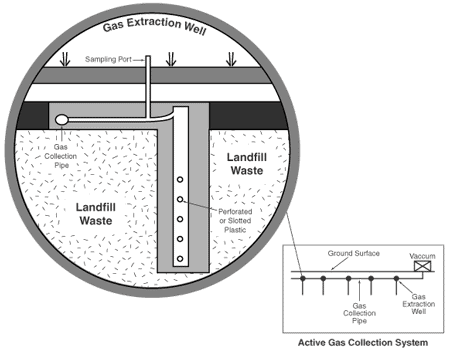
The landfill-to-energy process begins with garbage collected and brought to landfill operations. Much of it is organic and is broken down by bacteria in a natural process. Methane and other gasses known as landfill gas is produced. With special wells the gas is captured and piped to a processing facility.
After processing it is the same as natural gas and can be used the same way.


Each landfill gas "well" is just a couple pipes drilled into the ground.


Waste Management Partnering to Find Gas in the Trash: This project at the Altamont Landfill is only one of many which Waste Management plans to launch. They own 477 landfills and have announced intent to open 60 landfill gas projects by the end of 2012. Further there are 1,700 operating landfills in the U.S., and according to the the EPA’s Landfill Methane Outreach Program, they contain enough natural gas to produce 2,643 megawatts of electricity.

CARB tables of landfill gas composition shows the percentages of different constituents to landfill gas. On average it's 44% methane and 35% CO2, both are recognized as the leading components to greenhouse gas.

Clearly averting the emission of those gasses into the atmosphere would abate some greenhouse gas issues. However burning the landfill gas doesn't destroy the carbon. Therefore burning landfill gas cannot avert emission of the landfill gas. What it can do is replace the use of some fossil natural gas or fossil liquid fuels.


Production of 25 MW of Electricity Using Landfill Gas: Describes a project in Montreal (Canada) to build an electricity plant that uses landfill gas as its fuel. The plant cost CAD $37 million to build and produces 25 megawatts of power.

Video: Powering Up with Landfill Gas: Discusses a similar project at the University of New Hampshire. In the video it's mentioned they've been "flaring" their landfill gas, and are now instead using it to generate power. Flaring gas just means they're burning it with no attempt to capture any energy. Turning it from a flaring to power production situation is an improvement by any measure.

Waste-based Renewable Energy: Landfill operators place collection wells that act like straws throughout a landfill to draw out the methane gas. The gas is then piped to a compression and filtering unit beside the landfill. Technicians make sure that the gas is filtered properly before it is piped to its end user. The entire process is carefully managed to prevent odors and leakage of waste material.

California Energy Commission, Renewable Energy Research, Biomass and Landfill is a resource center about landfill gas research in California. When a landfill is capped, landfill gas (LFG) is generated as organic portions of the municipal solid wastes (MSW) are decomposed. Traditionally, landfill is not controlled and the expected period over which landfill gas will be produced may range from 50 to 100 years. But a usable landfill gas production rate that can be utilized lasts for only 10 to 15 years. A bioreactor is a controlled landfill in which water and other nutrient sources are added into the MSW to increase the landfill gas production rate.

The four basic uses of landfill gas is:
  1. medium-BTU gas production, 
  2. electricity generation, 
  3. injection into existing natural gas pipelines, 
  4. conversion to other chemical forms. California leads the nation in both the solid waste generation and number of landfill gas to electricity (LFGTE) facilities. The Puente Hills landfill, operated by the Los Angeles County Sanitation District, produces approximately 46.5 MW of power and is the largest LFGTE facility in the U.S.

US EPA Landfill Methane Outreach Program (LMOP): is a voluntary assistance and partnership program that promotes the use of landfill gas as a renewable, green energy source. Landfill gas is the natural by-product of the decomposition of solid waste in landfills and is comprised primarily of carbon dioxide and methane. By preventing emissions of methane (a powerful greenhouse gas) through the development of landfill gas energy projects, LMOP helps businesses, states, energy providers, and communities protect the environment and build a sustainable future.

Instead of allowing LFG to escape into the air, it can be captured, converted, and used as an energy source. Using LFG helps to reduce odors and other hazards associated with LFG emissions, and it helps prevent methane from migrating into the atmosphere and contributing to local smog and global climate change.

Is Landfill Gas Green Energy? Is a study by the Natural Resources Defense Council looking at just how "green" an energy can one get from landfill gas.
  • Combustion of raw LFG in a flare, an engine, or a turbine dramatically reduces the overall toxicity.
  • Collection and combustion dramatically reduces global warming impacts and toxicity.
  • Using LFG to generate electricity further reduces the greenhouse gas impacts and also reduces emissions of nitrogen oxides, sulfur dioxide and mercury. Burying garbage in landfills results in the release of more heat-trapping gases than any other waste-management option.
  • Because LFG is a by-product of landfills, and landfills are such a poor way to manage our waste, LFG can not be considered renewable.
An Overview of Landfill Gas Energy in the United States: Methane as GHG is over 20x more potent by weight than CO2.

Linde and Waste Management commission world’s largest landfill to liquefied natural gas facility

Altamont Landfill's gas fuels garbage trucks

World’s Largest Landfill Gas to LNG Plant Opens in California:

Landfill waste to power Waste Management hauling fleet

Landfill Gas to Energy

http://en.wikipedia.org/wiki/Biogas


Renewables and Alternate Fuels > Landfill Gas

Baltimore Landfill Gas Powers Up Coast Guard Yard

Production of Renewable Energy

Landfill Gas Resources and Technologies

Energy Companies To Harvest Durham Landfill Gas

Mexico’s President Applauds Monterrey’s Landfill Gas Plant as Model Renewable Energy Project for Latin America

Duke Energy Carolinas Signs Deal to Turn Landfill Gas into Energy

Waste Management to build 60 new landfill gas plants

LANDFILL GAS-TO-ENERGY PROJECT CASE STUDIES

Landfill gas–to–energy facility at Cedar Hills Regional Landfill

Landfill Gas Videos

allvoices

Tuesday, October 13, 2009

Tres Amigas Project in New Mexico promises more renewable energy through better electrical grid connectivity

A criticism of renewable energy resources like wind or solar power is the places where it's abundant are places with few people, and the places with many people don't have much of either wind or solar power. Thus to utilize wind or solar power means long distance electrical transmission through what's been characterized as an aging and inefficient national power grid. American Superconductor aims to undo this bottleneck with the Tres Amigas project which intends to be a highly efficient interconnection hub for the three main portions of America's power grid.

renewable-power.jpgThe "Saudi Arabia of Wind" is in the U.S. mid-west region, primarily a corridor from North Texas, along the front range of the Rockies, and into Wyoming and Minnesota. Similarly the deserts of the South West are prime places for solar power installations. Lots of wind and sun with few people, meaning that electricity from facilities installed there has to travel a long distance to reach their market. Further for that power to reach the east or west coast requires traversing what are said to be inefficient transfers to the Eastern or Western Interconnect.

tres-amigas.jpgThe design of the Tres Amigas project is a large triangle of underground superconducting cables connecting the three power grids. (get it? three power grids? tres amigas?) Each leg of the triangle can carry 5 gigawatts of electricity and the whole station will be on 22.5 square miles of land near Clovis NM.

A key component of the design is the "Superconductor Electricity Pipelines" product developed by American Superconductor. These pipelines have a copper core in a cryogenic environment maintained by a liquid nitrogen bath. Hence this form of superconductivity is created by supercold temperatures. The cables are buried underground by digging trenches creating an advantage over current long distance transmission using those tall towers which criss-cross the country. Their website is full of pictures of untouched rural landscapes which one supposes would result from widespread use of their electricity pipelines.

superconductive-cables.jpg

They claim the advantages of the "Superconductor Electricity Pipelines" include the following. However the claims are made for 1000 mile long transmission cables, and the Tres Amigas project is only due to cover a 22.5 square mile exchange point. It is not said whether this project includes any truly long distance transmission facilities beyond the exchange point.

  • Higher efficiency (97% rather than 91%) resulting in less transmission loss
  • Smaller land use impact (25 foot right of way versus 600 foot)
  • Good esthetics (buried cables are out of sight)
  • No electromagnetic field
  • Efficiency and CO2 emissions savings (presumably due to higher transmission efficiency)

Tres Amigas LLC claims these advantages:-

  • First system to connect America’s three power grids (Eastern Interconnect, Western Interconnect and Texas Interconnect)
  • Enhances the capacity, reliability and efficiency of America’s power grids
  • Assists the U.S. in achieving its renewable energy targets by carrying gigawatts of “green” power from region to region
  • Creates the nation’s first renewable energy trading hub
  • Utilizes the latest power grid technologies, including DC superconductor power cables, HVDC voltage source converters and energy storage systems

The project seems geared to tapping New Mexico's potential as a leading supplier of renewable energy. That and other state's of the South West have vast potential for producing renewably sourced electricity.

The information from Tres Amigas includes this curious statement: "Creates the nation’s first renewable energy trading hub". This raises echo's of Enron whose primary purpose was to operate an energy trading system.


allvoices

Friday, June 19, 2009

Build Baby Build

Description: 

A community website promoting renewable energy, and distributed energy systems. It includes blogs, community discussions, a jobs board, and more.


allvoices

Tuesday, January 27, 2009

Michigan Green

Description: 

Michigan GREEN is a non-profit group that consists of energy companies and consultants, together with government agencies, schools, colleges, universities and likemided individuals; that have joined forces to champion the cause of renewable energy and energy efficiency in Michigan and throughout the Nation.

extvideo: 

allvoices

Thursday, November 27, 2008

Western Renewable Energy Generation Information System (WREGIS)

Description: 

An independent, renewable energy tracking system for the region covered by the Western Electricity Coordinating Council (WECC). WREGIS tracks renewable energy generation from units that register in the system using verifiable data and creates renewable energy certificates (RECs) for this generation. WREGIS Certificates can be used to verify compliance with state and provincial regulatory requirements (Renewable Portfolio Standards, for example) and in voluntary market programs.

WREGIS is an accounting system designed to issue, register and track renewable energy certificates (RECs) for use in verification of compliance with state and provincial regulatory and voluntary market programs. The system can be accessed by both registered account holders and public users, but the functionality available to registered users is much higher than that available to the public. WREGIS account holders can manage their individual REC portfolios in one account; the same account will have numerous available sub-accounts into which the portfolios can be organized.

extvideo: 

allvoices

Wednesday, November 26, 2008

Canadian Renewable Fuels Association

Description: 

Founded in 1984, the Canadian Renewable Fuels Association (CRFA) is a non-profit organization with a mission to promote the use of renewable fuels for transportation through consumer awareness and government liaison activities.

The CRFA membership is composed of representatives from all levels of the ethanol and biodiesel industry, including: grain and cellulose ethanol producers, biodiesel producers, fuel technology providers, and agricultural associations.

extvideo: 

allvoices

Monday, November 24, 2008

Energy Efficiency and Renewable Energy: U.S. Dept of Energy

Description: 

EERE's programs conduct activities in partnership with the private sector, state and local government, DOE national laboratories, and universities. In July 2002, EERE reorganized to strengthen its focus on programs and these partnerships. The EERE mission is to strengthen America's energy security, environmental quality, and economic vitality in public-private partnerships that: Enhance energy efficiency and productivity; Bring clean, reliable and affordable energy technologies to the marketplace; and Make a difference in the everyday lives of Americans by enhancing their energy choices and their quality of life.

extvideo: 

allvoices

Canadian Renewable Fuels Association

Description: 

Founded in 1984, the Canadian Renewable Fuels Association (CRFA) is a non-profit organization with a mission to promote the use of renewable fuels for transportation through consumer awareness and government liaison activities.

The CRFA membership is composed of representatives from all levels of the ethanol and biodiesel industry, including: grain and cellulose ethanol producers, biodiesel producers, fuel technology providers, and agricultural associations.

extvideo: 

allvoices

A Global Overview of Renewable Energy Sources

Description: 

The AGORES site is designed to be a most extensive global international information centre and knowledge gateway for Renewable Energies. Originally it was built for the European Commission, but over the last few years, our site has been extended to the whole world's information on Renewable Energy.

extvideo: 

allvoices

Friday, November 14, 2008

A look at the Green-E Certification program

The Green-e program is meant to bolster customer confidence in the reliability of retail electricity products reflecting renewable energy generation, expand the retail market for electricity products incorporating renewable energy, provide customers clear information about retail "green" electricity products to enable them to make informed purchasing decisions, and encourage the deployment of electricity products that minimize air pollution and reduce greenhouse gas emissions. Clearly if our society is going to have a cleaner environment one thing to do is shift electricity generation from Coal to, well, practically anything else will be cleaner than Coal. The style to which we've become accustomed is hugely dependent on cheap energy derived from cheap fossil fuels, but the use of those fossil fuels causes huge problems for us all. Hence there is a need to switch to other resources.

The Green-E program is positioning itself as an arbiter of green electricity, and they offer a stamp of approval that is meant to give "customers" (us) comfort that Green-E certified services are powered by cleanly generated electricity.

The The Center for Resource Solutions manages the Green-E program.

The Green‑e Energy National Standard identifies many criteria renewable energy must meet to be certified. Energy must come from eligible sources of supply, like wind, solar, geothermal, biomass, or “low‑impact” hydropower. Only new renewable facilities can be used, ones built since 1997. Energy can’t be used to fulfill a state renewable energy goal, and can’t be “double counted" towards that goal. And marketing to consumers must be accurate—Green‑e performs a marketing compliance review twice a year to ensure that what they say is what you get.

In 2007, renewable energy generated to supply unique Green‑e Energy Certified products prevented emissions to the atmosphere of 5.5 million short tons of CO2, a gas that contributes to global climate change. An equivalent amount of average system power would produce 7,000 tons of SO2, which can lead to acid rain; 6,000 tons of NOx, which causes smog and groundlevel pollution; and over 11 tons of mercury, a toxic substance linked to neurological problems.

"Customers" can query through the site for Green-E certified electricity providers. These are organized by locale and the type of electrical generation. Each provider has a profile page on their site. For example the City of Palo Alto Utilities is listed as being Wind: 97%, Solar: 2%.

Green-e Climate Certified Carbon Offsets is a certification program for the sale of greenhouse gas (GHG) emission reduction products sold in the voluntary market. This is sales of carbon credits deriving from programs which Green-E certifies to be valid. The Green-e Climate Endorsed Programs are independent third-party greenhouse gas (GHG) Project Certification Programs that ensure specific GHG reduction projects result in real, verified, enforceable, permanent, and additional reductions. The specific principles and criteria that Endorsed Programs should meet are outlined in the Green-e Climate Standard. Sellers who seek Green-e Climate certification for the sales of GHG emission reduction products (offsets) must source from projects that are certified by one of the Endorsed Programs.

Why should an electricity provider get certification? They suggest that consumer confidence, quality assurance, recognition, etc, are the benefits. It is a voluntary program so a company has to seek to become qualified.

There are six easy steps to certification and it is these steps where I begin to be concerned about whether Green-E has any standing. The steps are to essentially fill out some paperwork, and send it in along with an application fee. One would hope that the Green-E organization sends out auditors to verify the claims that a provider makes in their application form. One would hope that Green-E inspects facilities on a regular basis, that they take air samples and other measurements, etc. But the process does not discuss any of this, it simply says they review application forms and take money.

There is discussion of an audit procedure but The Verification Process Audit uses company contracts, invoices, and billing statements.


allvoices