Showing posts with label Biomass. Show all posts

Tuesday, June 11, 2013

US Senate passes Farm Bill with more than $800M in mandatory funding for bioenergy programs

The United States Senate passed a five-year farm bill-the Agriculture Reform, Food, and Jobs Act of 2013 (S.954)-containing more than $800 million in mandatory funding for energy programs. The bill also contains funding to grow the renewable chemicals industry.

The Congressional Budget Office CBO estimates that direct spending stemming from the program authorization under the 12 titles in S. 954 would total $955 billion over the 2014-2023 period. That 10-year total reflects the bill's authorization of expiring programs through 2018 and an extension of those authorizations through 2023. The energy title (Title IX) of the bill contains:

  • $261 million in mandatory for the Renewable Energy for America Program (REAP), which will provide a streamlined application process for farmers and rural businesses applying for renewable and energy efficient system projects.

  • $193 million in mandatory funding for the Biomass Crop Assistance Program, which provides support for farmers who wish to plant energy crops to produce and use biomass crops for conversion to advanced biofuels or bioenergy. Agricultural producers in BCAP project areas may contract with the Department of Agriculture to receive biomass crop establishment payments up to 50 percent of costs, plus annual payments in amounts determined by the Secretary in subsequent years to help to compensate for lost opportunity costs until crops are established.

    860 growers in 12 states plant 59,000 acres of new energy crops a year with the assistance of Biomass Crop Assistance Program, according to the Biotechnology Industry Association (BIO).

  • $216 million in mandatory funding for the Biorefinery Assistance Program, which provides loan guarantees for renewable energy projects, expands eligibility to include biobased manufacturing and renewable chemicals.

  • $130 million for the Biomass Research and Development Initiative. The bill will reauthorize funding for research on biomass feedstock development for bioenergy and biobased products.

  • The bill will reauthorize and modify USDA's BioPreferred Program and the Federal Government Procurement Preference Program. Many of the modifications are adopted from the "Make it Here, Grow it Here" initiative which includes reporting of biobased purchases by the federal agencies, auditing and enforcement of the biobased and education/outreach activities. The program will receive $15 million in mandatory funding.

  • Bioenergy Program for Advanced Biofuels. This program provides production payments for advanced bioenergy sources such as methane digesters, advanced biofuels and biopower.

  • Community Wood Energy Program. This program provides competitive, cost-share grants for communities to supply public buildings with energy from sustainably-harvested wood from the local area.

The energy title also funds USDA programs that help jumpstart additional biorefinery construction for advanced biofuels and renewable chemicals, dedicated energy crop feedstock development and consumer demand of biobased products-all encouraging further commercialization of the renewable industry.

The House is still working on its version of the Farm Bill (H.R.1947, the Federal Agriculture Reform and Risk Management Act of 2013).

http://www.greencarcongress.com/2013/06/farmbill-20130611.htm


allvoices

Thursday, March 7, 2013

China-US team concludes duckweed biorefineries can be cost-competitive with petroleum-based processes

Researchers from the US and China have determined that a duckweed biorefinery producing a range of gasoline, diesel and kerosene products can be economically competitive with petroleum-based processes, even in some cases without environmental legislation that penalizes greenhouse gas emissions. A paper describing their analysis of four different scenarios for duckweed biorefineries is published in the ACS journal Industrial & Engineering Chemistry Research.

Duckweed, an aquatic plant that floats on or near the surface of still or slow-moving freshwater, is attractive as a raw material for biofuel production. It grows fast, thrives in wastewater that has no other use, does not impact the food supply and can be harvested more easily than algae and other aquatic plants. However, few studies have been done on the use of duckweed as a raw material for biofuel production.

The team, comprising researchers from Princeton University; Peking University; Institute of Process Engineering, Chinese Academy of Sciences; and PetroChina company, investigated four different thermochemical pathways for the production of gasoline, diesel, and kerosene from gasified duckweed synthesis gas as the intermediate:

  • Low-temperature and high-temperature Fischer‚àíTropsch processes (LTFT and HTFT) using both iron and cobalt based catalysts. Clean syngas is converted to hydrocarbons via cobalt or iron-based catalysts operating at either low or high temperature. The residue/wax produced from FT synthesis is directed to a hydrocracker, and the vapor phase C3‚àíC22 hydrocarbons are sent for further upgrading.

  • Methanol to hydrocarbons via the methanol-to-gasoline (MTG) or methanol-to-olefins (MTO) processes. The hydrocarbons are refined into the final liquid products using ZSM-5 catalytic conversion, oligomerization, alkylation, isomerization, hydrotreating, reforming, and hydrocracking.

Baliban2
Baliban3
Fischer‚àíTropsch (FT) synthesis flowsheet. Credit: ACS, Baliban et al. Click to enlarge.Methanol synthesis and upgrading flowsheet. Credit: ACS, Baliban et al. Click to enlarge.

The team developed a process synthesis framework to select the refining pathway that will produce the liquid fuels at the lowest possible cost. The used the synthesis framework to determine the effect of refinery capacity and liquid fuel composition on the overall system cost, the refinery topological design, the process material/energy balances, and the lifecycle greenhouse gas emissions.

The researchers used four case studies focused on two target capacities (i.e., 1,000 and 5,000 bpd) and two product compositions (i.e., unrestricted and US demand ratios of gasoline, diesel, and kerosene) to demonstrate the capability of the process synthesis framework and determine the process design that has the lowest overall cost.

The price of crude oil for which the duckweed BTL refineries will be competitive is $100/bbl for the 1 kBD unrestricted study, $69/bbl for the 5 kBD unrestricted study, $105/bbl for the 1 kBD US ratio study, and $72/bbl for the 5 kBD US ratio study. An important highlight for these four studies is the strong use of methanol synthesis opposed to FT synthesis. The lack of inert production during methanol synthesis allows for the use of a large internal synthesis gas loop and less complex synthesis gas conversion design within the refinery. The methanol can be readily converted to gasoline, diesel, and kerosene using a ZSM- 5 catalyst.

A parametric analysis on the duckweed purchase price indicates that there exists a threshold price of duckweed above which the refinery will no longer be economically competitive with crude oil refining. This threshold level for duckweed purchase depends on the desired refinery capacity and will decrease as the capacity decreases.

If crude oil was priced around $105/bbl, then the 1 kBD refineries would be economically competitive with a duckweed purchase price of $50/dry metric ton. A reduction in the duckweed purchase price to $30/dry metric ton will make the 1 kBD duckweed refineries competitive at crude prices above $95/bbl. For the 5 kBD refineries, the process synthesis framework demonstrates the economic viability at a crude price above $72/bbl for duckweed purchase prices at $50/dry metric ton. If this purchase price was raised to $70/dry metric ton, the refineries would remain competitive at crude priced above $82/bbl.

-Baliban et al.

The US National Science Foundation and the Chinese Academy of Sciences provided funding for the research.

Resources

  • Richard C. Baliban, Josephine A. Elia, Christodoulos A. Floudas, Xin Xiao, Zhijian Zhang, Jie Li, Hongbin Cao, Jiong Ma, Yong Qiao, and Xuteng Hu (2013) Thermochemical Conversion of Duckweed Biomass to Gasoline, Diesel, and Jet Fuel: Process Synthesis and Global Optimization. Industrial & Engineering Chemistry Research doi: 10.1021/ie3034703

http://www.greencarcongress.com/2013/03/arpa-e-to-issue-new-funding-op

http://www.greencarcongress.com/2013/03/duckweed-20130307.htm


allvoices

Tuesday, January 22, 2013

New metabolic engineering tool for microbial cell factories for chemicals, fuels and materials

A South Korean research team led by Sang Yup Lee at the Korea Advanced Institute of Science and Technology (KAIST) has developed a new metabolic engineering tool to construct efficiently microbial cell factories producing desired chemicals, fuels and materials. The new tool allows fine control of gene expression level by employing synthetic small regulatory RNAs; a paper on the work is published in the journal Nature Biotechnology.

Biotechnologists have been working to develop sustainable processes for the production of chemicals, fuels and materials from renewable non-food biomass. One promising technology is the use of microbial cell factories for the efficient production of desired chemicals and materials.

When microorganisms are isolated from nature, their performance in producing desired products is rather poor. Metabolic engineering is performed to improve the metabolic and cellular characteristics to achieve enhanced production of desired product at high yield and productivity. Since the performance of microbial cell factory is very important in lowering the overall production cost of the bioprocess, many different strategies and tools have been developed for the metabolic engineering of microorganisms.

One of the big challenges in metabolic engineering is to find the best platform organism and to find those genes to be engineered so as to maximize the production efficiency of the desired chemical. Even Escherichia coli, the most widely utilized simple microorganism, has thousands of genes, the expression of which is highly regulated and interconnected to finely control cellular and metabolic activities. Thus, the complexity of cellular genetic interactions is beyond our intuition and thus it is very difficult to find effective target genes to engineer.

Together with gene amplification strategy, gene knockout strategy has been an essential tool in metabolic engineering to redirect the pathway fluxes toward our desired product formation. However, experimenting to engineer many genes can be rather difficult due to the time and effort required; for example, a gene deletion experiment can take a few weeks depending on the microorganisms.

Furthermore, as certain genes are essential or play important roles for the survival of a microorganism, gene knockout experiments cannot be performed. Moreover, there are many different microbial strains one can employ. There are more than 50 different E. coli strains that metabolic engineers can consider. Since gene knockout experiments are hard-coded (that is, one should repeat the gene knockout experiments for each strain), the result cannot be easily transferred from one strain to another.

The paper addresses this issue and suggests a new strategy for identifying gene targets to be knocked out or knocked down through the use of synthetic small RNA. Professor Lee's team reported that synthetic small RNA can be employed for finely controlling the expression levels of multiple genes at the translation level. Already well-known for their systems metabolic engineering strategies, Professor Lee's team added one more strategy to efficiently develop microbial cell factories for the production of chemicals and materials.

Here, we report the development of a general strategy for modulating gene expression at the translation stage using synthetic sRNAs that are rationally designed (rather than randomly screened), and we provide proof-of-concept applications to metabolic engineering by increasing the production of tyrosine and cadaverine in E. coli. The synthetic sRNA-based strategy reported here is advantageous over conventional gene-knockout strategies and other large-scale target identification strategies because of its easy implementation and because it does not rely on pre-constructed strain libraries.

-Na et al.

Gene expression works like this: the hard-coded blueprint (DNA) is transcribed into messenger RNA (mRNA), and the coding information in mRNA is read to produce protein by ribosomes. Conventional genetic engineering approaches have often targeted modification of the blueprint itself (DNA) to alter organism's physiological characteristics. Again, engineering the blueprint itself takes much time and effort, and in addition, the results obtained cannot be transferred to another organism without repeating the whole set of experiments.

Professor Lee and his colleagues aimed at controlling the gene expression level at the translation stage through the use of synthetic small RNA. They created novel RNAs that can regulate the translation of multiple messenger RNAs (mRNA), and consequently varying the expression levels of multiple genes at the same time. Briefly, synthetic regulatory RNAs interrupt gene expression process from DNA to protein by destroying the messenger RNAs to different yet controllable extents. The advantages of taking this strategy of employing synthetic small regulatory RNAs include simple, easy and high-throughput identification of gene knockout or knockdown targets, fine control of gene expression levels, transferability to many different host strains, and possibility of identifying those gene targets that are essential.

As proof-of-concept demonstration of the usefulness of this strategy, Professor Lee and his colleagues applied it to develop engineered E. coli strains capable of producing an aromatic amino acid tyrosine, which is used for stress symptom relief, food supplements, and precursor for many drugs. They examined a large number of genes in multiple E. coli strains, and developed a highly efficient tyrosine producer. Also, they were able to show that this strategy can be employed to an already metabolically engineered E. coli strain for further improvement by demonstrating the development of highly efficient producer of cadaverine, an important platform chemical for nylon in the chemical industry.

The design principles and the engineering strategy using synthetic sRNAs reported here are generalizable to other bacteria and applicable in developing superior producer strains. The ability to fine-tune target genes with designed sRNAs provides substantial advantages over gene-knockout strategies and other large-scale target identification strategies owing to its easy implementation, ability to modulate chromosomal gene expression without modifying those genes and because it does not require construction of strain libraries.

-Na et al.

This new strategy, being simple yet very powerful for systems metabolic engineering, could facilitate the efficient development of microbial cell factories capable of producing chemicals, fuels and materials from renewable biomass.

This work was supported by the Technology Development Program to Solve Climate Changes on Systems Metabolic Engineering for Biorefineries (NRF-2012-C1AAA001-2012M1A2A2026556) and the Intelligent Synthetic Biology Center through the Global Frontier Project (2011-0031963) of the Ministry of Education, Science and Technology (MEST) through the National Research Foundation of Korea.

Resources

  • Dokyun Na, Seung Min Yoo, Hannah Chung, Hyegwon Park, Jin Hwan Park, and Sang Yup Lee (2013) Metabolic engineering of Escherichia coli using synthetic small regulatory RNAs. Nature Biotechnology doi: 10.1038/nbt.2461

http://www.greencarcongress.com/2013/01/na-20130122.htm


allvoices

Thursday, November 5, 2009

TechnoSanity #31: A look at Waste Management and landfill gas energy resources

The other day talking with a friend I noticed a Waste Management trash truck roll by and had this sudden reflection "I own a piece of that truck". I own a few shares of WM's stock, hence I "own" a tiny fraction of the truck that rolled by. She was surprised and asked "you don't do socially responsible investing, then?" While I try to select companies with socially responsible thinking my investments are not SRI pure. Take that for whatever it is worth, the stereotype attached to Waste Management is they're an evil corporation just doing the worst thing possible with the trash we throw away while painting their trucks green to pretend they are environmental stewards. Greenwashing, in other words. Turns out that stereotype isn't entirely accurate.


Turns out that Waste Management has a bunch of environmental information on their web site. While putting brochures on a web site doesn't fix the environment it shows they are at least thinking about it and recognizant of their role in environmental stewardship. I don't know how well they do as environmental stewards. However it's clear they have the potential to play a large role due to their position of receiving all the trash people throw out. That trash is potentially a resource stream which can be turned into products.


This text will be replaced


It's not just Waste Management but every "trash" company in the world, if there were technology whereby they could perform recycling on a huge scale of every item that comes into their hands it would perhaps erase the word "landfill" from our vocabulary. Unfortunately that potential isn't anywhere near being implementable. One small piece to the puzzle is the "landfill gas" that lots of waste companies, Waste Management included, is looking at tapping. This gas is a form of natural gas and can be burned just as natural gas, and being a biogas has some positive environmental benefit over fossil natural gas. It can also be liquified into a fuel to use in trucks.

On November 2, 2009, Waste Management and the Linde Group announced a project at the Altamont Landfill (near Livermore CA) which makes liquified natural gas from landfill gas, the LNG will be used to power Waste Management's trucks. They believe the plant has the capacity to produce 13,000 gallons of fuel per day, from that one plant. Given that it's from just one of Waste Management's landfills, it's mind boggling to think of the quantity of landfill gas emitted from all landfills around the country (or around the world), and how much fuel that represents.

Energy production from landfill gas turns out to be a big deal. Yahoogling for "landfill gas renewable energy" turns up lots of interesting articles and resources. The following is just a smattering of what I found.


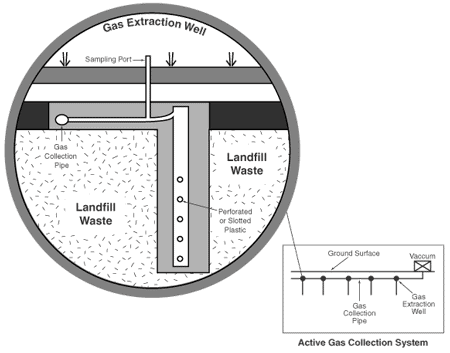
The landfill-to-energy process begins with garbage collected and brought to landfill operations. Much of it is organic and is broken down by bacteria in a natural process. Methane and other gasses known as landfill gas is produced. With special wells the gas is captured and piped to a processing facility.
After processing it is the same as natural gas and can be used the same way.


Each landfill gas "well" is just a couple pipes drilled into the ground.


Waste Management Partnering to Find Gas in the Trash: This project at the Altamont Landfill is only one of many which Waste Management plans to launch. They own 477 landfills and have announced intent to open 60 landfill gas projects by the end of 2012. Further there are 1,700 operating landfills in the U.S., and according to the the EPA’s Landfill Methane Outreach Program, they contain enough natural gas to produce 2,643 megawatts of electricity.

CARB tables of landfill gas composition shows the percentages of different constituents to landfill gas. On average it's 44% methane and 35% CO2, both are recognized as the leading components to greenhouse gas.

Clearly averting the emission of those gasses into the atmosphere would abate some greenhouse gas issues. However burning the landfill gas doesn't destroy the carbon. Therefore burning landfill gas cannot avert emission of the landfill gas. What it can do is replace the use of some fossil natural gas or fossil liquid fuels.


Production of 25 MW of Electricity Using Landfill Gas: Describes a project in Montreal (Canada) to build an electricity plant that uses landfill gas as its fuel. The plant cost CAD $37 million to build and produces 25 megawatts of power.

Video: Powering Up with Landfill Gas: Discusses a similar project at the University of New Hampshire. In the video it's mentioned they've been "flaring" their landfill gas, and are now instead using it to generate power. Flaring gas just means they're burning it with no attempt to capture any energy. Turning it from a flaring to power production situation is an improvement by any measure.

Waste-based Renewable Energy: Landfill operators place collection wells that act like straws throughout a landfill to draw out the methane gas. The gas is then piped to a compression and filtering unit beside the landfill. Technicians make sure that the gas is filtered properly before it is piped to its end user. The entire process is carefully managed to prevent odors and leakage of waste material.

California Energy Commission, Renewable Energy Research, Biomass and Landfill is a resource center about landfill gas research in California. When a landfill is capped, landfill gas (LFG) is generated as organic portions of the municipal solid wastes (MSW) are decomposed. Traditionally, landfill is not controlled and the expected period over which landfill gas will be produced may range from 50 to 100 years. But a usable landfill gas production rate that can be utilized lasts for only 10 to 15 years. A bioreactor is a controlled landfill in which water and other nutrient sources are added into the MSW to increase the landfill gas production rate.

The four basic uses of landfill gas is:
  1. medium-BTU gas production, 
  2. electricity generation, 
  3. injection into existing natural gas pipelines, 
  4. conversion to other chemical forms. California leads the nation in both the solid waste generation and number of landfill gas to electricity (LFGTE) facilities. The Puente Hills landfill, operated by the Los Angeles County Sanitation District, produces approximately 46.5 MW of power and is the largest LFGTE facility in the U.S.

US EPA Landfill Methane Outreach Program (LMOP): is a voluntary assistance and partnership program that promotes the use of landfill gas as a renewable, green energy source. Landfill gas is the natural by-product of the decomposition of solid waste in landfills and is comprised primarily of carbon dioxide and methane. By preventing emissions of methane (a powerful greenhouse gas) through the development of landfill gas energy projects, LMOP helps businesses, states, energy providers, and communities protect the environment and build a sustainable future.

Instead of allowing LFG to escape into the air, it can be captured, converted, and used as an energy source. Using LFG helps to reduce odors and other hazards associated with LFG emissions, and it helps prevent methane from migrating into the atmosphere and contributing to local smog and global climate change.

Is Landfill Gas Green Energy? Is a study by the Natural Resources Defense Council looking at just how "green" an energy can one get from landfill gas.
  • Combustion of raw LFG in a flare, an engine, or a turbine dramatically reduces the overall toxicity.
  • Collection and combustion dramatically reduces global warming impacts and toxicity.
  • Using LFG to generate electricity further reduces the greenhouse gas impacts and also reduces emissions of nitrogen oxides, sulfur dioxide and mercury. Burying garbage in landfills results in the release of more heat-trapping gases than any other waste-management option.
  • Because LFG is a by-product of landfills, and landfills are such a poor way to manage our waste, LFG can not be considered renewable.
An Overview of Landfill Gas Energy in the United States: Methane as GHG is over 20x more potent by weight than CO2.

Linde and Waste Management commission world’s largest landfill to liquefied natural gas facility

Altamont Landfill's gas fuels garbage trucks

World’s Largest Landfill Gas to LNG Plant Opens in California:

Landfill waste to power Waste Management hauling fleet

Landfill Gas to Energy

http://en.wikipedia.org/wiki/Biogas


Renewables and Alternate Fuels > Landfill Gas

Baltimore Landfill Gas Powers Up Coast Guard Yard

Production of Renewable Energy

Landfill Gas Resources and Technologies

Energy Companies To Harvest Durham Landfill Gas

Mexico’s President Applauds Monterrey’s Landfill Gas Plant as Model Renewable Energy Project for Latin America

Duke Energy Carolinas Signs Deal to Turn Landfill Gas into Energy

Waste Management to build 60 new landfill gas plants

LANDFILL GAS-TO-ENERGY PROJECT CASE STUDIES

Landfill gas–to–energy facility at Cedar Hills Regional Landfill

Landfill Gas Videos

allvoices

Wednesday, September 19, 2007

Green Energy TV

Description: 

An online "tv network" of sorts hosting video presentations on green energy and related topics.

extvideo: 

allvoices

Wednesday, June 6, 2007

Camelina: A Promising Low-Input Oilseed

Description: 

A scientific paper covering the Camelina plant. It is attractive because it can grow on marginal land, and produces a high oil content. The paper is over 10 years old and only covers interest in edible oils, but today there is growing interest in using oils to produce biodiesel.


allvoices

Monday, January 1, 2007

Biomass Research & Development Initiative

Description: 

The Biomass Research and Development Initiative (BRDI) is the multi-agency effort to coordinate and accelerate all Federal biobased products and bioenergy research and development.


allvoices