The other day talking with a friend I noticed a Waste Management trash truck roll by and had this sudden reflection "I own a piece of that truck". I own a few shares of WM's stock, hence I "own" a tiny fraction of the truck that rolled by. She was surprised and asked "you don't do socially responsible investing, then?" While I try to select companies with socially responsible thinking my investments are not SRI pure. Take that for whatever it is worth, the stereotype attached to Waste Management is they're an evil corporation just doing the worst thing possible with the trash we throw away while painting their trucks green to pretend they are environmental stewards. Greenwashing, in other words. Turns out that stereotype isn't entirely accurate.

Turns out that Waste Management has a bunch of environmental information on their web site. While putting brochures on a web site doesn't fix the environment it shows they are at least thinking about it and recognizant of their role in environmental stewardship. I don't know how well they do as environmental stewards. However it's clear they have the potential to play a large role due to their position of receiving all the trash people throw out. That trash is potentially a resource stream which can be turned into products.
It's not just Waste Management but every "trash" company in the world, if there were technology whereby they could perform recycling on a huge scale of every item that comes into their hands it would perhaps erase the word "landfill" from our vocabulary. Unfortunately that potential isn't anywhere near being implementable. One small piece to the puzzle is the "landfill gas" that lots of waste companies, Waste Management included, is looking at tapping. This gas is a form of natural gas and can be burned just as natural gas, and being a biogas has some positive environmental benefit over fossil natural gas. It can also be liquified into a fuel to use in trucks.
On November 2, 2009, Waste Management and the Linde Group announced a project at the Altamont Landfill (near Livermore CA) which makes liquified natural gas from landfill gas, the LNG will be used to power Waste Management's trucks. They believe the plant has the capacity to produce 13,000 gallons of fuel per day, from that one plant. Given that it's from just one of Waste Management's landfills, it's mind boggling to think of the quantity of landfill gas emitted from all landfills around the country (or around the world), and how much fuel that represents.
Energy production from landfill gas turns out to be a big deal. Yahoogling for "landfill gas renewable energy" turns up lots of interesting articles and resources. The following is just a smattering of what I found.

The landfill-to-energy process begins with garbage collected and brought to landfill operations. Much of it is organic and is broken down by bacteria in a natural process. Methane and other gasses known as landfill gas is produced. With special wells the gas is captured and piped to a processing facility.
After processing it is the same as natural gas and can be used the same way.


Each landfill gas "well" is just a couple pipes drilled into the ground.

Waste Management Partnering to Find Gas in the Trash: This project at the Altamont Landfill is only one of many which Waste Management plans to launch. They own 477 landfills and have announced intent to open 60 landfill gas projects by the end of 2012. Further there are 1,700 operating landfills in the U.S., and according to the the EPA’s Landfill Methane Outreach Program, they contain enough natural gas to produce 2,643 megawatts of electricity.
CARB tables of landfill gas composition shows the percentages of different constituents to landfill gas. On average it's 44% methane and 35% CO2, both are recognized as the leading components to greenhouse gas.
Clearly averting the emission of those gasses into the atmosphere would abate some greenhouse gas issues. However burning the landfill gas doesn't destroy the carbon. Therefore burning landfill gas cannot avert emission of the landfill gas. What it can do is replace the use of some fossil natural gas or fossil liquid fuels.

Production of 25 MW of Electricity Using Landfill Gas: Describes a project in Montreal (Canada) to build an electricity plant that uses landfill gas as its fuel. The plant cost CAD $37 million to build and produces 25 megawatts of power.
Video: Powering Up with Landfill Gas: Discusses a similar project at the University of New Hampshire. In the video it's mentioned they've been "flaring" their landfill gas, and are now instead using it to generate power. Flaring gas just means they're burning it with no attempt to capture any energy. Turning it from a flaring to power production situation is an improvement by any measure.
Waste-based Renewable Energy: Landfill operators place collection wells that act like straws throughout a landfill to draw out the methane gas. The gas is then piped to a compression and filtering unit beside the landfill. Technicians make sure that the gas is filtered properly before it is piped to its end user. The entire process is carefully managed to prevent odors and leakage of waste material.
California Energy Commission, Renewable Energy Research, Biomass and Landfill is a resource center about landfill gas research in California. When a landfill is capped, landfill gas (LFG) is generated as organic portions of the municipal solid wastes (MSW) are decomposed. Traditionally, landfill is not controlled and the expected period over which landfill gas will be produced may range from 50 to 100 years. But a usable landfill gas production rate that can be utilized lasts for only 10 to 15 years. A bioreactor is a controlled landfill in which water and other nutrient sources are added into the MSW to increase the landfill gas production rate.
The four basic uses of landfill gas is:
US EPA Landfill Methane Outreach Program (LMOP): is a voluntary assistance and partnership program that promotes the use of landfill gas as a renewable, green energy source. Landfill gas is the natural by-product of the decomposition of solid waste in landfills and is comprised primarily of carbon dioxide and methane. By preventing emissions of methane (a powerful greenhouse gas) through the development of landfill gas energy projects, LMOP helps businesses, states, energy providers, and communities protect the environment and build a sustainable future.
Instead of allowing LFG to escape into the air, it can be captured, converted, and used as an energy source. Using LFG helps to reduce odors and other hazards associated with LFG emissions, and it helps prevent methane from migrating into the atmosphere and contributing to local smog and global climate change.
Is Landfill Gas Green Energy? Is a study by the Natural Resources Defense Council looking at just how "green" an energy can one get from landfill gas.
Linde and Waste Management commission world’s largest landfill to liquefied natural gas facility
Altamont Landfill's gas fuels garbage trucks
World’s Largest Landfill Gas to LNG Plant Opens in California:
Landfill waste to power Waste Management hauling fleet
Landfill Gas to Energy
http://en.wikipedia.org/wiki/Biogas
Renewables and Alternate Fuels > Landfill Gas
Baltimore Landfill Gas Powers Up Coast Guard Yard
Production of Renewable Energy
Landfill Gas Resources and Technologies
Energy Companies To Harvest Durham Landfill Gas
Mexico’s President Applauds Monterrey’s Landfill Gas Plant as Model Renewable Energy Project for Latin America
Duke Energy Carolinas Signs Deal to Turn Landfill Gas into Energy
Waste Management to build 60 new landfill gas plants
LANDFILL GAS-TO-ENERGY PROJECT CASE STUDIES
Landfill gas–to–energy facility at Cedar Hills Regional Landfill
Landfill Gas Videos

Turns out that Waste Management has a bunch of environmental information on their web site. While putting brochures on a web site doesn't fix the environment it shows they are at least thinking about it and recognizant of their role in environmental stewardship. I don't know how well they do as environmental stewards. However it's clear they have the potential to play a large role due to their position of receiving all the trash people throw out. That trash is potentially a resource stream which can be turned into products.
This text will be replaced
It's not just Waste Management but every "trash" company in the world, if there were technology whereby they could perform recycling on a huge scale of every item that comes into their hands it would perhaps erase the word "landfill" from our vocabulary. Unfortunately that potential isn't anywhere near being implementable. One small piece to the puzzle is the "landfill gas" that lots of waste companies, Waste Management included, is looking at tapping. This gas is a form of natural gas and can be burned just as natural gas, and being a biogas has some positive environmental benefit over fossil natural gas. It can also be liquified into a fuel to use in trucks.
On November 2, 2009, Waste Management and the Linde Group announced a project at the Altamont Landfill (near Livermore CA) which makes liquified natural gas from landfill gas, the LNG will be used to power Waste Management's trucks. They believe the plant has the capacity to produce 13,000 gallons of fuel per day, from that one plant. Given that it's from just one of Waste Management's landfills, it's mind boggling to think of the quantity of landfill gas emitted from all landfills around the country (or around the world), and how much fuel that represents.
Energy production from landfill gas turns out to be a big deal. Yahoogling for "landfill gas renewable energy" turns up lots of interesting articles and resources. The following is just a smattering of what I found.

The landfill-to-energy process begins with garbage collected and brought to landfill operations. Much of it is organic and is broken down by bacteria in a natural process. Methane and other gasses known as landfill gas is produced. With special wells the gas is captured and piped to a processing facility.
After processing it is the same as natural gas and can be used the same way.
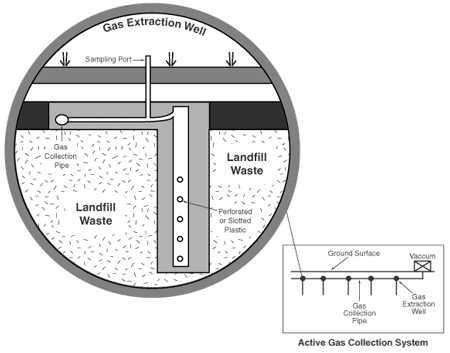

Each landfill gas "well" is just a couple pipes drilled into the ground.

Waste Management Partnering to Find Gas in the Trash: This project at the Altamont Landfill is only one of many which Waste Management plans to launch. They own 477 landfills and have announced intent to open 60 landfill gas projects by the end of 2012. Further there are 1,700 operating landfills in the U.S., and according to the the EPA’s Landfill Methane Outreach Program, they contain enough natural gas to produce 2,643 megawatts of electricity.
CARB tables of landfill gas composition shows the percentages of different constituents to landfill gas. On average it's 44% methane and 35% CO2, both are recognized as the leading components to greenhouse gas.
Clearly averting the emission of those gasses into the atmosphere would abate some greenhouse gas issues. However burning the landfill gas doesn't destroy the carbon. Therefore burning landfill gas cannot avert emission of the landfill gas. What it can do is replace the use of some fossil natural gas or fossil liquid fuels.

Production of 25 MW of Electricity Using Landfill Gas: Describes a project in Montreal (Canada) to build an electricity plant that uses landfill gas as its fuel. The plant cost CAD $37 million to build and produces 25 megawatts of power.
Video: Powering Up with Landfill Gas: Discusses a similar project at the University of New Hampshire. In the video it's mentioned they've been "flaring" their landfill gas, and are now instead using it to generate power. Flaring gas just means they're burning it with no attempt to capture any energy. Turning it from a flaring to power production situation is an improvement by any measure.
Waste-based Renewable Energy: Landfill operators place collection wells that act like straws throughout a landfill to draw out the methane gas. The gas is then piped to a compression and filtering unit beside the landfill. Technicians make sure that the gas is filtered properly before it is piped to its end user. The entire process is carefully managed to prevent odors and leakage of waste material.
California Energy Commission, Renewable Energy Research, Biomass and Landfill is a resource center about landfill gas research in California. When a landfill is capped, landfill gas (LFG) is generated as organic portions of the municipal solid wastes (MSW) are decomposed. Traditionally, landfill is not controlled and the expected period over which landfill gas will be produced may range from 50 to 100 years. But a usable landfill gas production rate that can be utilized lasts for only 10 to 15 years. A bioreactor is a controlled landfill in which water and other nutrient sources are added into the MSW to increase the landfill gas production rate.
The four basic uses of landfill gas is:
- medium-BTU gas production,
- electricity generation,
- injection into existing natural gas pipelines,
- conversion to other chemical forms. California leads the nation in both the solid waste generation and number of landfill gas to electricity (LFGTE) facilities. The Puente Hills landfill, operated by the Los Angeles County Sanitation District, produces approximately 46.5 MW of power and is the largest LFGTE facility in the U.S.
US EPA Landfill Methane Outreach Program (LMOP): is a voluntary assistance and partnership program that promotes the use of landfill gas as a renewable, green energy source. Landfill gas is the natural by-product of the decomposition of solid waste in landfills and is comprised primarily of carbon dioxide and methane. By preventing emissions of methane (a powerful greenhouse gas) through the development of landfill gas energy projects, LMOP helps businesses, states, energy providers, and communities protect the environment and build a sustainable future.
Instead of allowing LFG to escape into the air, it can be captured, converted, and used as an energy source. Using LFG helps to reduce odors and other hazards associated with LFG emissions, and it helps prevent methane from migrating into the atmosphere and contributing to local smog and global climate change.
Is Landfill Gas Green Energy? Is a study by the Natural Resources Defense Council looking at just how "green" an energy can one get from landfill gas.
- Combustion of raw LFG in a flare, an engine, or a turbine dramatically reduces the overall toxicity.
- Collection and combustion dramatically reduces global warming impacts and toxicity.
- Using LFG to generate electricity further reduces the greenhouse gas impacts and also reduces emissions of nitrogen oxides, sulfur dioxide and mercury. Burying garbage in landfills results in the release of more heat-trapping gases than any other waste-management option.
- Because LFG is a by-product of landfills, and landfills are such a poor way to manage our waste, LFG can not be considered renewable.
Linde and Waste Management commission world’s largest landfill to liquefied natural gas facility
Altamont Landfill's gas fuels garbage trucks
World’s Largest Landfill Gas to LNG Plant Opens in California:
Landfill waste to power Waste Management hauling fleet
Landfill Gas to Energy
http://en.wikipedia.org/wiki/Biogas
Renewables and Alternate Fuels > Landfill Gas
Baltimore Landfill Gas Powers Up Coast Guard Yard
Production of Renewable Energy
Landfill Gas Resources and Technologies
Energy Companies To Harvest Durham Landfill Gas
Mexico’s President Applauds Monterrey’s Landfill Gas Plant as Model Renewable Energy Project for Latin America
Duke Energy Carolinas Signs Deal to Turn Landfill Gas into Energy
Waste Management to build 60 new landfill gas plants
LANDFILL GAS-TO-ENERGY PROJECT CASE STUDIES
Landfill gas–to–energy facility at Cedar Hills Regional Landfill
Landfill Gas Videos


 During a speech by President Obama on Tuesday (Oct 27, 2009) about a new program of funding for smart grid technology he talked about the need for an all-hands-on-deck mobilization such as the ones which won World War II or the Apollo space missions. He then went on to discuss legislation which would make clean energy profitable naming "clean coal technology, safe nuclear power, sustainably grown biofuels, and energy we harness from the wind, waves, and sun" as the candidates. Whether coal or nuclear power could ever be made 'clean' is a matter of derision in many quarters (note: there is more to consider than carbon emissions). However a recent article in the journal Science has set off a debate about the accounting which leads many to believe biofuels are carbon neutral wonder fuels.
 In a recent press release the Energy Information Administration said it expects lower heating costs this winter. "We expect household bills for space-heating fuels will be 8 percent lower than a year ago, with the average household spending $960 in the October through March winter heating season, a decrease of $84 from last winter," said EIA Administrator Richard Newell. "The lower bills primarily reflect lower fuel prices, although slightly milder weather than last winter will also contribute to less fuel use in many areas. We expect the largest decreases in fuel expenses in households using natural gas and propane."


 While she has a very good point her question is rather disingenuous. Obviously if the toxic chemicals are removed from gaseous emissions the toxic chemicals still exist and have to be put somewhere, the question is "where"? The NY Times article goes on to discuss that "no federal regulations specifically govern the disposal of power plant discharges into waterways or landfills" and that some regulators attempt to use the Clean Water Act to regulate such emissions. The Clean Water Act is insufficient for this purpose and in any case the NY Times article reports even for plants who are regulated under this act the vast majority are in violation and are not fined or otherwise sanctioned by the agencies who would be regulating them.
  The "Saudi Arabia of Wind" is in the U.S. mid-west region, primarily a corridor from North Texas, along the front range of the Rockies, and into Wyoming and Minnesota. Similarly the deserts of the South West are prime places for solar power installations. Lots of wind and sun with few people, meaning that electricity from facilities installed there has to travel a long distance to reach their market. Further for that power to reach the east or west coast requires traversing what are said to be inefficient transfers to the Eastern or Western Interconnect.
  The design of the Tres Amigas project is a large triangle of underground superconducting cables connecting the three power grids. (get it? three power grids? tres amigas?) Each leg of the triangle can carry 5 gigawatts of electricity and the whole station will be on 22.5 square miles of land near Clovis NM.