Thursday, November 5, 2009

Law 270.7 - Lecture 11 - Biomass & Biofuels, and Landfill Gas

Description: 

Pollution Control Laws and Renewable Energy - November 5, 2008

A look at current practice and potential related to biomass use for powerplants, and the evolving effort to develop viable biofuels for transportation. Addressing the energy payback and carbon neutrality of biomass and biofuels; Indirect effect of water pollution and waste management laws on the development of renewable energy.


allvoices

Landfill Gas = Alternative Energy

Description: 

3 Rivers Landfill allows a manufacturing plant to use an alternative source of energy


allvoices

TechnoSanity #31: A look at Waste Management and landfill gas energy resources

The other day talking with a friend I noticed a Waste Management trash truck roll by and had this sudden reflection "I own a piece of that truck". I own a few shares of WM's stock, hence I "own" a tiny fraction of the truck that rolled by. She was surprised and asked "you don't do socially responsible investing, then?" While I try to select companies with socially responsible thinking my investments are not SRI pure. Take that for whatever it is worth, the stereotype attached to Waste Management is they're an evil corporation just doing the worst thing possible with the trash we throw away while painting their trucks green to pretend they are environmental stewards. Greenwashing, in other words. Turns out that stereotype isn't entirely accurate.


Turns out that Waste Management has a bunch of environmental information on their web site. While putting brochures on a web site doesn't fix the environment it shows they are at least thinking about it and recognizant of their role in environmental stewardship. I don't know how well they do as environmental stewards. However it's clear they have the potential to play a large role due to their position of receiving all the trash people throw out. That trash is potentially a resource stream which can be turned into products.


This text will be replaced


It's not just Waste Management but every "trash" company in the world, if there were technology whereby they could perform recycling on a huge scale of every item that comes into their hands it would perhaps erase the word "landfill" from our vocabulary. Unfortunately that potential isn't anywhere near being implementable. One small piece to the puzzle is the "landfill gas" that lots of waste companies, Waste Management included, is looking at tapping. This gas is a form of natural gas and can be burned just as natural gas, and being a biogas has some positive environmental benefit over fossil natural gas. It can also be liquified into a fuel to use in trucks.

On November 2, 2009, Waste Management and the Linde Group announced a project at the Altamont Landfill (near Livermore CA) which makes liquified natural gas from landfill gas, the LNG will be used to power Waste Management's trucks. They believe the plant has the capacity to produce 13,000 gallons of fuel per day, from that one plant. Given that it's from just one of Waste Management's landfills, it's mind boggling to think of the quantity of landfill gas emitted from all landfills around the country (or around the world), and how much fuel that represents.

Energy production from landfill gas turns out to be a big deal. Yahoogling for "landfill gas renewable energy" turns up lots of interesting articles and resources. The following is just a smattering of what I found.


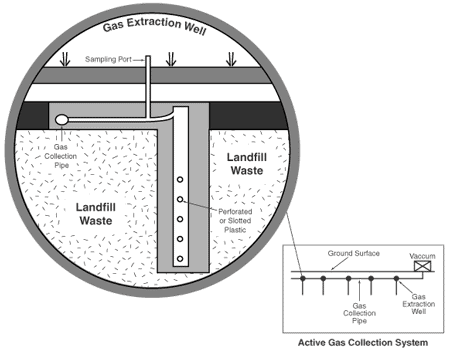
The landfill-to-energy process begins with garbage collected and brought to landfill operations. Much of it is organic and is broken down by bacteria in a natural process. Methane and other gasses known as landfill gas is produced. With special wells the gas is captured and piped to a processing facility.
After processing it is the same as natural gas and can be used the same way.


Each landfill gas "well" is just a couple pipes drilled into the ground.


Waste Management Partnering to Find Gas in the Trash: This project at the Altamont Landfill is only one of many which Waste Management plans to launch. They own 477 landfills and have announced intent to open 60 landfill gas projects by the end of 2012. Further there are 1,700 operating landfills in the U.S., and according to the the EPA’s Landfill Methane Outreach Program, they contain enough natural gas to produce 2,643 megawatts of electricity.

CARB tables of landfill gas composition shows the percentages of different constituents to landfill gas. On average it's 44% methane and 35% CO2, both are recognized as the leading components to greenhouse gas.

Clearly averting the emission of those gasses into the atmosphere would abate some greenhouse gas issues. However burning the landfill gas doesn't destroy the carbon. Therefore burning landfill gas cannot avert emission of the landfill gas. What it can do is replace the use of some fossil natural gas or fossil liquid fuels.


Production of 25 MW of Electricity Using Landfill Gas: Describes a project in Montreal (Canada) to build an electricity plant that uses landfill gas as its fuel. The plant cost CAD $37 million to build and produces 25 megawatts of power.

Video: Powering Up with Landfill Gas: Discusses a similar project at the University of New Hampshire. In the video it's mentioned they've been "flaring" their landfill gas, and are now instead using it to generate power. Flaring gas just means they're burning it with no attempt to capture any energy. Turning it from a flaring to power production situation is an improvement by any measure.

Waste-based Renewable Energy: Landfill operators place collection wells that act like straws throughout a landfill to draw out the methane gas. The gas is then piped to a compression and filtering unit beside the landfill. Technicians make sure that the gas is filtered properly before it is piped to its end user. The entire process is carefully managed to prevent odors and leakage of waste material.

California Energy Commission, Renewable Energy Research, Biomass and Landfill is a resource center about landfill gas research in California. When a landfill is capped, landfill gas (LFG) is generated as organic portions of the municipal solid wastes (MSW) are decomposed. Traditionally, landfill is not controlled and the expected period over which landfill gas will be produced may range from 50 to 100 years. But a usable landfill gas production rate that can be utilized lasts for only 10 to 15 years. A bioreactor is a controlled landfill in which water and other nutrient sources are added into the MSW to increase the landfill gas production rate.

The four basic uses of landfill gas is:
  1. medium-BTU gas production, 
  2. electricity generation, 
  3. injection into existing natural gas pipelines, 
  4. conversion to other chemical forms. California leads the nation in both the solid waste generation and number of landfill gas to electricity (LFGTE) facilities. The Puente Hills landfill, operated by the Los Angeles County Sanitation District, produces approximately 46.5 MW of power and is the largest LFGTE facility in the U.S.

US EPA Landfill Methane Outreach Program (LMOP): is a voluntary assistance and partnership program that promotes the use of landfill gas as a renewable, green energy source. Landfill gas is the natural by-product of the decomposition of solid waste in landfills and is comprised primarily of carbon dioxide and methane. By preventing emissions of methane (a powerful greenhouse gas) through the development of landfill gas energy projects, LMOP helps businesses, states, energy providers, and communities protect the environment and build a sustainable future.

Instead of allowing LFG to escape into the air, it can be captured, converted, and used as an energy source. Using LFG helps to reduce odors and other hazards associated with LFG emissions, and it helps prevent methane from migrating into the atmosphere and contributing to local smog and global climate change.

Is Landfill Gas Green Energy? Is a study by the Natural Resources Defense Council looking at just how "green" an energy can one get from landfill gas.
  • Combustion of raw LFG in a flare, an engine, or a turbine dramatically reduces the overall toxicity.
  • Collection and combustion dramatically reduces global warming impacts and toxicity.
  • Using LFG to generate electricity further reduces the greenhouse gas impacts and also reduces emissions of nitrogen oxides, sulfur dioxide and mercury. Burying garbage in landfills results in the release of more heat-trapping gases than any other waste-management option.
  • Because LFG is a by-product of landfills, and landfills are such a poor way to manage our waste, LFG can not be considered renewable.
An Overview of Landfill Gas Energy in the United States: Methane as GHG is over 20x more potent by weight than CO2.

Linde and Waste Management commission world’s largest landfill to liquefied natural gas facility

Altamont Landfill's gas fuels garbage trucks

World’s Largest Landfill Gas to LNG Plant Opens in California:

Landfill waste to power Waste Management hauling fleet

Landfill Gas to Energy

http://en.wikipedia.org/wiki/Biogas


Renewables and Alternate Fuels > Landfill Gas

Baltimore Landfill Gas Powers Up Coast Guard Yard

Production of Renewable Energy

Landfill Gas Resources and Technologies

Energy Companies To Harvest Durham Landfill Gas

Mexico’s President Applauds Monterrey’s Landfill Gas Plant as Model Renewable Energy Project for Latin America

Duke Energy Carolinas Signs Deal to Turn Landfill Gas into Energy

Waste Management to build 60 new landfill gas plants

LANDFILL GAS-TO-ENERGY PROJECT CASE STUDIES

Landfill gas–to–energy facility at Cedar Hills Regional Landfill

Landfill Gas Videos

allvoices

Sunday, November 1, 2009

TechnoSanity #30: Peak Oil and the UKERC Peak Oil report

You are missing some Flash content that should appear here! Perhaps your browser cannot display it, or maybe it did not initialize correctly.

In October 2009 the UK Energy Research Centre released an indepth report on Peak Oil. In this episode of the Technosanity Podcast we go over several articles discussing the report.

Articles discussed in the podcast:-

"Global Oil Depletion" a report on Peak Oil by the UK Energy Research Centre is my summary of the report. Of especial interest is the following two charts.

This shows the rate of oil discovery over the years, and shows that the peak of oil discovery occurred in the early 1960's. The lack of discovering oil is not due to a lack of searching, it is due to a lack of finding. The lack of finding new significant oil discoveries implies strongly that the fossil oil resources on this planet have all been tapped out.

The important wedges in this chart are "Crude oil - fields yet to be developed" and "Crude oil - fields yet to be found". Looking at the chart it appears the IEA expects on the order of 40 million barrels/day will come from those two sources. The first, fields yet to be developed, is oil that's known to exist but hasn't had infrastructure installed to extract the oil. The fields yet to be developed require extensive investment to install that infrastructure.

The fields yet to be found simply aren't known yet. Where are they? We don't know. The IEA is putting a lot of credence in the wish or hope or expectation that those fields will be found. Maybe they'll be found, maybe not.

There needs to be a long lead time to install the infrastructure - something like 10 years to build out an oil field full of oil derricks etc.

Peak Oil - It's Still Coming, It May Be Delayed Though, Whither Resilience and Transition? Why ‘Peak Oil’ Has Yet to Outlive its Usefulness, Oil production could peak in 10 years' time, Have We Reached Peak Oil? and A post-oil world gets less sci-fi by the day all go over the same UKERC study.

The UKERC study warns that the world society will have to find 64 million barrels/day in production by 2030 to replace the decrease in production they expect by then. This is shown on the above chart. But it's not clear where that oil will come from.

Canadian tar sands? The Canadians doubt they'll ever get more than 3 million barrels/day in production.

There are four key issues about oil production and which together point to a supply crunch sooner rather than later.

  • declining output: That's peak oil, once we're past the global oil peak it means oil production is declining
  • declining discoveries: Discoveries have been in a decline since the early 60's, it means discoveries do not match the rate of use, and that we're due to run out no matter what
  • increasing demand: Population increases and other factors mean continuing demand increases
  • insufficient projects in the pipeline: Without oil infrastructure projects to exploit the known fields, the oil production capacity cannot increase even with fields we know about

Reflections from ASPO: Contradiction, EROI, and Future Energy Supplies is a look back at the recent conference of the Association for the Study of Peak Oil. He talks at length about Energy Return on Investment (EROI) in regard to some claims about "Shale Gas" resources. Someone claims there's 200+ years of natural gas available from Shale Gas. However what's missing from that claim is the EROI of extracting that gas, and if it requires a lot of energy to extract natural gas from shale then is it worthwhile to do so?

TechnoSanity #30: Peak Oil and the UKERC Peak Oil report


allvoices

Thursday, October 29, 2009

Are biofuels truly carbon neutral wonder fuels?

DSCN0896-web.jpgDuring a speech by President Obama on Tuesday (Oct 27, 2009) about a new program of funding for smart grid technology he talked about the need for an all-hands-on-deck mobilization such as the ones which won World War II or the Apollo space missions.  He then went on to discuss legislation which would make clean energy profitable naming "clean coal technology, safe nuclear power, sustainably grown biofuels, and energy we harness from the wind, waves, and sun" as the candidates.  Whether coal or nuclear power could ever be made 'clean' is a matter of derision in many quarters (note: there is more to consider than carbon emissions).  However a recent article in the journal Science has set off a debate about the accounting which leads many to believe biofuels are carbon neutral wonder fuels.

The pair of studies in the Oct 22 issue of Science demonstrate that the way biofuels are currently produced is nowhere near carbon neutral.  Current biofuel production involves actions like cutting down rain forest in 3rd world countries to plant palm or sugar cane plantations, then converting palm oil to biodiesel or sugar cane syrup to ethanol.  Under Kyoto Protocol accounting methods the environmental impact of clearing the land to grow these crops is not counted in the carbon footprint of the fuel.

The supposed advantage of biofuels is that the carbon in the fuel came from today rather carbon which was sequestered millions of years ago.  Fossil fuels are created from biological organisms which lived and died millions of years ago, were buried, and through geological forces became oil.  Biofuels are derived from biological organisms which live today, are harvested, and the biological material converted into oil.  In both cases the result is oil but burning fossil oil causes a net increase in carbon while burning oil from biofuels does not cause a net increase in carbon.  At least that's the theory, the reality is not so clear.

What's at issue is the indirect impact of each biofuel source.  Cutting down a rainforest releases a massive quantity of carbon which otherwise would have remained sequestered in the trees.  Further the loss of rainforest means that much less global forest to convert carbon dioxide into the oxygen we animals breath.

On Oct 23 the Global Renewable Fuels Alliance issued a press release stating several assertions supporting the argument that biofuels are clean.  Perhaps the best is: Advanced biofuels are now beginning to be made from non-recyclable municipal solid waste (i.e. garbage), forestry and wood waste, algae, and agricultural residues.  An article in Biomass magazine goes further to discuss how any release of carbon from "recently living organisms" has no overall effect on atmospheric CO2 levels and is therefore carbon neutral.

A recent study by the United Nations Energy Program comes to a different conclusion, namely that biofuels should be considered climate-friendly (or not) based on the source. Whether the biofuel was made from a crop grown specifically to create that fuel, or whether it came from crop residues, this has very different implications.  The report also talked about acreage requirements for different energy sources.  For example the land required to grow biofuels can be enormous, while much less land is required to generate an equivalent amount of energy from wind or solar.

Reposted from: Are biofuels truly carbon neutral wonder fuels?

For more info: 
Fixing a Critical Climate Accounting Error

REALITY CHECK: Journal Science Abandons Real Science for Science-Fiction

Ethanol Groups Refute Science Article

Science article on GHG accounting misses the mark on biofuels

U.N. Study Urges Caution on Biofuels

Biofuels Error Stated Carbon Advantage?  

Carbon advantage of biofuels may be overstated

Tallying Biofuels' Real Environmental Cost

Is Global Scale Biofuels Production Good or Bad for Climate Change?

Proposal To Place Biomass, Biofuels Under CO2 Emission Cap Is Based On Flawed Logic, BIO Says

Sins of Emission


allvoices

Wednesday, October 21, 2009

U.S. EIA Expects Lower Home Heating Costs This Winter

eia-price-summary.jpgIn a recent press release the Energy Information Administration said it expects lower heating costs this winter. "We expect household bills for space-heating fuels will be 8 percent lower than a year ago, with the average household spending $960 in the October through March winter heating season, a decrease of $84 from last winter," said EIA Administrator Richard Newell. "The lower bills primarily reflect lower fuel prices, although slightly milder weather than last winter will also contribute to less fuel use in many areas. We expect the largest decreases in fuel expenses in households using natural gas and propane."

They expect the lower 48 states to be 1 percent warmer than last year. Warmer weather obviously requires less fuel for heating. However temperature variations are regional in that the midwest is expected to be warmer but the west is expected to be colder. I live in California and the rainy season seems to have already started, a harbinger for a "cold" winter.

Another factoid is that larger supplies of natural gas means a lower price for natural gas. Their projected 15-percent decrease in average household expenditures results from an 11-percent decrease in prices and a decline in consumption of 4 percent based on the forecast of warmer weather (in the midwest, where natural gas is the primary heating fuel) than last winter.

The Northeast accounts for 80 percent of heating fuel consumption. In that region, the average household is projected to spend 3 percent less ($60) than last winter as a result of a 2-percent decrease in consumption, with regional prices about 1 percent less than last winter.

Homes heated with propane are expected to spend an average of $280 (14 percent) less this winter but that decrease varies broadly by region.

Households heating primarily with electricity can expect to spend an average of $20 (2 percent) less than last winter. The number of households heating with electricity is growing faster, at an estimated annual rate of 2.5 percent, than all the other major heating fuels.


allvoices

Sunday, October 18, 2009

"Global Oil Depletion" a report on Peak Oil by the UK Energy Research Centre

The UK Energy Research Centre handles research into energy issues for all of Britain. On Oct 8, 2009 they released an indepth study of oil production, the ways to measure oil reserves, estimate current and future production, etc. They paint a picture of peak oil and the need to move to other energy resources. It's not that they are whole-hog embracers of peak oil, instead this is a serious and indepth explanation of the issues with eye opening charts, data and discussion. The following is my summarization of the main report, they also published 7 additional reports containing a flood of technical data.

Abundant supplies of cheap liquid fuels form the foundation of modern industrial economies and at present the vast majority of these fuels are obtained from ‘conventional’ oil. Conventional Oil is the high quality stuff that got us hooked the potent energy source that it is.

Many forecast a near-term peak and subsequent terminal decline in the production of conventional oil as a result of the physical depletion of the resource. Others claim rising oil prices will stimulate investment that will increase supply to meet demand. But those who point to stimulated investment tend to reply on use of nonconventional oil such as tar sands conversion. Also as we'll see financial troubles raise the doubt of whether the required production capacity investments can be made, because of doubt over availability of capital.

While there is popular attention on peak oil, official attention is scarce or dismissive. "Most governments exhibit little concern about oil depletion, several oil companies have been publicly dismissive and the majority of energy analysts remain sceptical."

Key conclusions

  1. The mechanisms leading to a ‘peaking’ of conventional oil production are well understood and provide identifiable constraints on its future supply at both the regional and global level.
  2. Despite large uncertainties in the available data, sufficient information is available to allow the status and risk of global oil depletion to be adequately assessed.
  3. There is potential for improving consensus on important and long-standing controversies such as the source and magnitude of ‘reserves growth’.
    • "The oil industry must continually invest to replace the decline in production from existing fields. The average rate of decline from fields that are past their peak of production is at least 6.5%/year globally, while the corresponding rate of decline from all currently-producing fields is at least 4%/year. This implies that approximately 3 mb/d of new capacity must be added each year, simply to maintain production at current levels - equivalent to a new Saudi Arabia coming on stream every three years.
    • Decline rates are on an upward trend as more giant fields enter decline, as production shifts towards smaller, younger and offshore fields and as changing production methods lead to more rapid post-peak decline. As a result, more than two thirds of current crude oil production capacity may need to be replaced by 2030, simply to prevent production from falling. At best, this is likely to prove extremely challenging.
    • Oil reserves cannot be produced at arbitrarily high rates. There are physical, engineering and economic constraints upon both the rate of depletion of a field or region and the pattern of production over time. For example, the annual production from a region has rarely exceeded 5% of the remaining recoverable resources and most regions have reached their peak well before half of their recoverable resources have been produced. Supply forecasts that assume or imply significant departures from this historical experience are likely to require careful justification."
  4. Methods for estimating resource size and forecasting future supply have important limitations that need to be acknowledged.
  5. Large resources of conventional oil may be available, but these are unlikely to be accessed quickly and may make little difference to the timing of the global peak.
  6. The risks presented by global oil depletion deserve much more serious attention by the research and policy communities.

Policy implications

  1. it seems likely that mitigation will prove challenging owing to both the scale of investment required and the associated lead times.
  2. Even with incentives associated with climate change policy, there will be strong incentives to exploit high carbon non-conventional fuels. (the massive amounts of coal just waiting to be liquified)
  3. Investment in large-scale mitigation efforts will be inhibited by oil price uncertainty and volatility and seems unlikely to occur without significant policy support.

total-liquid-fuel-production.jpg

Current economic problems have lead to a major reduction in global oil demand, a major fall in price ($150/bbl in July 2008 to $40/bbl in Jan 2009) and the cancellation or delay of many projects that would act to increase production capacity. Given the long lead time required to get oil production projects underway the cancellation of projects makes likely a supply crunch in a few years e.g. if global oil demand increases again will the demand increase faster than the production projects can get restarted?

oil-peak-us.jpg

oil-peak-britain.jpg

These are examples of a couple oil peaks. Conventional oil production raised to a point and then declined once production levels were unable to be sustained.

oil-classification.jpg

Classifying the different kinds of oil is key to gauging the problem. When conventional enters terminal decline will there be other resources which can pick up the slack? There's nothing magical about fossil oil, it's possible to make oil through other means. Some questions about this are: Is it possible to replace the supply provided by conventional oil by some other fuel source? Are the replacement fuel(s) better or worse for the environment? Do the replacement fuels have as high an energy return on investment as conventional oil does? How quickly can the switchover to other resources be made?

The energy return on investment (EROI) is a measure of the net energy gain from the production of oil and other resources, once the energy used in extraction and processing has been taken into account.

oil-discovery-trends.jpg

This is again focused on conventional oil and shows that the peak of discovery for conventional oil was in the early 1960's. Note well above in the key findings that to make up for production decline that new production sources are required at a rate of another "Saudi Arabia" (3 million bbl/day equivalent) every 3 years. The world society has been coasting on the fumes of old oil discoveries for over 40 years. The lack of new oil major field discoveries represents a major problem looming in front of us.

eia-production-forecast.jpg

The U.S. DOE EIA produced this forecast of future oil production. Note the two wedges in the middle. They are marked "Crude Oil - fields yet to be found" and "Crude oil - fields yet to be developed". These wedges represent the production shortfall that's looming in front of us. The key phrase is "...yet to be..." because that is production capacity which does not currently exist. For it to exist new oil wells, pipelines, refineries, and transport ships have to be built. Often the new oil is far offshore so "oil well" is an expensive oil platform. Then there are the oil fields yet to be discovered. Where are they and why haven't they been found yet?

Much of the paper is devoted to statistical modeling of recoverable reserves, the claimed reserves, the potential for new discoveries, and the decline rates.

There is a big controversy about claimed oil reserves. Some companies appear to be playing tricks with their claimed reserves and that the publicly claimed numbers are widely thought to be bogus. The root cause is the relative power strength of OPEC decision making is based on their reserves figures. Saudi Arabia claims to have the most reserves but their numbers have been suspicious.


allvoices