Tuesday, October 4, 2011

Perhaps the rise of clean technology must require new companies to be started, rather than revolutionizing the incumbent companies.

Greenstart is focused on addressing the dependence on fossil fuels by facilitating the startup of companies to provide alternatives.

Applications for the January 26 – April 11 2012 program will be accepted until Saturday, November 12, 2011. Note: Applications are reviewed as they are received, so you have a better chance of being accepted if you apply early.


Cleantech Accelerator Greenstart Seeks Startups for Second Program

Startups to Receive $25,000 - $100,000, Mentoring and Access to Investors; Applications Close 11/18

SAN FRANCISCO, Oct. 3, 2011 /PRNewswire/ -- Greenstart, the first startup accelerator exclusively designed for cleantech companies, seeks applications for the company's second three-month accelerator session, which begins on January 23.  Submissions will be accepted until November 18 at www.greenstart.com/apply.

Greenstart discovers dynamic new business concepts from cleantech entrepreneurs and provides them with the essentials to grow successful next generation clean energy companies. Greenstart is particularly targeting "fast cleantech" startups - those that expand the use of clean energy or reduce the use of dirty energy while being capital efficient and quick to market.

Companies will be expected to develop a prototype of their product or service within 45 days, share a prototype with customers for validation and feedback within the program's timeframe, and have a strong likelihood of producing revenues within six months.

Entrepreneurs accepted into the program will receive $25,000 - $100,000 in seed funding, comprehensive mentoring from successful entrepreneurs, cleantech leaders and executives, and introductions to leading cleantech angel and venture capital investors.  During the program, participants will be expected to spend the majority of their time in San Francisco, where they will have access to the company's open and collaborative workspace, networking events, and additional company resources. The program will conclude with an investor presentation day on April 11, 2012.

"We are thrilled with the quality of companies that have joined our first program," said Greenstart Managing Partner Mitch Lowe, "We cannot wait to see what kind of bright ideas and entrepreneurial spirits come through the second round of applications."

Greenstart is currently working with its first four debut companies: SmarterShade, Sylvatex, Tenrehte Technologies, and Wa.tt.  For its next iteration, Greenstart intends to expand its program to 6-8 companies.

About Greenstart:

Greenstart is a cleantech accelerator program providing a fast runway to success for entrepreneurs addressing the energy challenge.  Greenstart provides seed funding, mentoring, and connections with fellow entrepreneurs and investors in order to give startups an advantage in launching the cleantech ideas of tomorrow.  The company is based in San Francisco. Additional information can be found atwww.greenstart.com.

SOURCE  Greenstart

CONTACT: Jane Park, 1-415-309-4305jane@bluepractice.com
Web Site: http://www.greenstart.com


allvoices

Monday, October 3, 2011

US Dept of Energy supporting rooftop solar power at U.S. Military Housing

The U.S. Military has a lot of housing on bases around the country, and in other countries, right?  So why not use that purchasing power to increase sales of solar panels?


Energy Department Loan Guarantee Would Support Large-Scale Rooftop Solar Power for U.S. Military Housing

September 7, 2011 - 2:10pm

Washington D.C. – U.S. Energy Secretary Steven Chu today announced the offer of a conditional commitment for a partial guarantee of a $344 million loan that will support the SolarStrong Project, which is expected to be a record expansion of residential rooftop solar power in the United States.  Under the SolarStrong Project, SolarCity Corporation will install, own and operate up to 160,000 rooftop solar installations on as many as 124 U.S. military bases in up to 33 states.  SolarCity expects the project to fund approximately 750 construction jobs over five years and 28 full time operating jobs.  Many of the jobs are expected to be filled by U.S. veterans and military family members, who will be recruited, trained and employed to install, operate and maintain the photovoltaic (PV) systems.

“This is the largest domestic residential rooftop solar project in history,” said Secretary Chu.  “This groundbreaking project is expected to create hundreds of jobs for Americans and provide clean, renewable power to our military families. It can also be a model for other large-scale rooftop solar projects that help America regain its lead in the solar industry.”

The project, which could create up to 371 megawatts of new solar capacity, includes the installation of residential rooftop PV systems on existing privatized military family residences and other privatized buildings, such as community centers, administrative offices, maintenance buildings and storage warehouses.  The project will provide low-cost, renewable electricity to privatized military housing and is expected to avoid over 250,000 metric tons of carbon dioxide annually.  The SolarStrong Project will have the added benefit of helping the Department of Defense (DOD), the single-largest energy consumer in the U.S., secure its energy needs from domestic renewable sources that are independent from the utility grid, at no additional cost to taxpayers.  DOD has a stated goal that 25 percent of all energy consumed by 2025 shall be supplied from renewable sources.

The project will be rolled out over five years, starting with a four megawatt installation at Hickam Air Force base in Hawaii, with construction currently underway.  SolarStrong is expected to sell electricity produced from the projects through long-term electricity sales agreements or lease solar systems through long-term lease contracts.

USRG Renewable Finance, an affiliate of US Renewables Group, is acting as lead lender in partnership with Bank of America Merrill Lynch.  USRG Renewable Finance submitted the application under the Financial Institution Partnership Program (FIPP).  In a FIPP financing, the Department of Energy guarantees up to 80 percent of a loan provided to a renewable energy project by qualified financial institutions.

The Department of Energy's Loan Programs Office administers three separate programs:  the Title XVII Section 1703 and Section 1705 loan guarantee programs, and the Advanced Technology Vehicle Manufacturing (ATVM) loan program.   The loan guarantee programs support the deployment of commercial technologies along with innovative technologies that avoid, reduce, or sequester greenhouse gas emissions, while ATVM supports the development of advanced vehicle technologies.  To date, the Department has issued loans, loan guarantees or offered conditional commitments for loan guarantees totaling nearly $40 billion to support more than 40 clean energy projects across the United States, including several of the world’s largest solar generation facilities, three geothermal projects, the world’s largest wind farm, and the nation’s first new nuclear power plant in three decades.  For more information, please visit http://www.lpo.energy.gov.


allvoices

Friday, September 30, 2011

Yergin's flawed view of the future of the Age of Oil

Daniel Yergin has a new book out about the oil industry.  It's a sequel to his acclaimed earlier book, The Prize: The Epic Quest for Oil, Money and Power.  In the new book, The Quest: Energy, Security, and the Remaking of the Modern World, he discusses "energy" as the engine of global political and economic change, as well as central to the battle over climate change.  The scope of the new book includes Beijing and China's growth, the oil reserves in the Caspian Sea, conflicts in the Middle East, political power struggles in Washington DC, technology development in Silicon Valley, and more.

Salon.COM just posted an interview with Daniel Yergin which shows his intelligence and knowledge, but also a somewhat flawed view.  (See the link below)  Basically he's too quick to discount peak oil, and too confident on new technology to save our bacon.  I see a lot in the interview to agree with, and think he has a lot of important things to say.

Some context is the high oil prices in 2008 that had everybody all concerned.  That is, until the financial crash in the fall of 2008 that overwhelmed our attention span.  Since 2008 the price has gone up and down in a way that has many thinking "market manipulation by greedy tycoons".  The common refrain against peak oil concerns is that obviously the price fluctuations aren't due to supply concerns, but due to market manipulation.  I'm sure that market manipulation is a large part of the price fluctuations, but the core issue is that the easily tapped oil that's cheap to produce cannot sustain production levels to support the energy needs of our society.  As that supply of cheaply produced oil tightens we're going to see many issues arise.

The Salon interview starts by asking him about the validity of Peak Oil

The peak oil argument is that we are already halfway through the world's endowment of recoverable oil. The argument that I am making is that the endowment is much larger, and technology keeps enlarging what we can recover.

He goes on to discuss some unacknowledged oil resources:

  • an offshore formation in Brazil called "presalt" (oil found under a thick layer of salt lying just beneath the seabed).
  • The Bakken formation (a rock formation yielding shale, or "tight" oil) which is now producing 450,000 barrels of oil a day, up from 10,000 barrels a day recently.

These are sources of fossil oil, to be sure.  But are they examples of the sort of easily tapped cheaply produced oil reserves our society grew up on?  No.

The presalt formations in Brazil have significant reserves (5-8 billion barrels in the Tupi field, with several other known fields bringing the totals much higher).  The oil is light-sweet-crude that's easily tapped and processed.  However, it's in deep water way off shore.  The Tupi field is 160 miles off-shore from Rio De Janeiro.  The water is 6,600 feet deep, and the oil is another 15,000 feet below the water.  This is extremely deep drilling that's going to be highly costly to tap, and if there's an accident at the well might I remind you of the Deep Water Horizon disaster in the summer of 2010?

The Bakken Formation, as a shale oil reserve, will be requiring high energy inputs to extract oil.  We're talking about rocks that are a bit oily, rather than freely flowing oil.  The process to extract oil from these rocks requires heat and steam, which requires energy inputs to get the oil.

The point of mentioning these technological hurdles is that it shows Yergin is not taking into account the Energy Return on Investment.  If it costs you a barrel of oil's worth of energy to get a barrel of oil, you're at a wash in terms of energy gain.  What made the early years of the Age of Oil so successful was the energy gain at 100-to-1 ratios, where you'd spend 1 barrel of oil worth of energy, and get back 100 (or more) barrels of oil from the well.  Over the years this ratio has shrunk considerably.

Yergin does suggest there have been recurring fears that we'll run out of oil.

There have been recurrent periods of great fear of running out of oil and it goes back to when oil was first developed as a commercial business in western Pennsylvania in the 19th century. It was always mysterious and people were predicting it would come to an end and we'd have to go back to using whale oil or coal or so forth. But each time there is this anxiety, what happens is new technology, new innovations, new areas open up, and the supply picture suddenly looks much better. So this current peak oil discussion is really the latest manifestation of what has been a recurrent feature since people started using and developing oil. But when you look at the numbers, we see that there is an additional supply coming in. My view is that rather than facing an imminent decline we'll see production of oil liquids continue to expand for a few more decades and then it'll come to a plateau. It won't necessarily fall off sharply.

I don't know enough to predict the shape of the fossil oil production/demand curves in the coming years.  However it's telling that he uses the phrase "oil liquids" because that includes the possibilities of producing liquid oil products from sources other than fossil oil.

What the peak oil community fails to take into account is that fossil oil isn't the only source of oil liquids.  There are plenty of plants and animal sources that could be tapped.  Further tapping biomass sources (plants and animals) does not worsen the carbon footprint in the atmosphere, because it doesn't re-introduce carbon that had been sequestered zillions of years ago.  However the concern with biomass sources is the competition against use of biomass for other purposes such as food, clothing, timber, paper, etc.

In any case as he points out, new fossil oil resources have to be developed, which takes time and money.  There may not be enough time for these new fossil oil resources to be developed before the oil supply crunch hits us hard.  And there may not be enough money, given the current debt crisis rocking the world financial markets.

The next thing they talk about is the global energy dominance struggle between China and the rest of the world.  Yergin says the Western powers (Europe, U.S., Japan) is going to see a decrease in fossil oil demand because "we are going to be driving more efficient cars by 2025.. [that are] supposed to get up to 64 miles to the gallon."

Okay, yes, the Obama Administration did push for stronger CAFE standards which require much higher miles/gallon efficiencies by 2025.  While the car companies do produce high efficiency cars for sale in Europe they've dragged their feet in doing so for America.  Higher fuel efficiency will decrease the oil demand curve and he later says "energy conservation" is grossly underestimated because it is in effect an energy source.

However one thing going on about China is that consumption which formerly happened in the West is now happening in China due to the outsourcing of manufacturing etc to China.

Yergin refers to a Japanese term, "Mottainai", which he describes as "too precious to waste."

In the U.S. we had so much oil for so long that we don't understand fossil oil as "too precious to waste".  He suggests, and I agree, that we need to rearrange our thinking about fossil oil.

I see a lot in the interview to agree with.  For example the "energy security" issue that is a huge threat to the U.S. (and other countries).  The "energy" (better term is to call it what it is; fossil oil) that drives our society is the foundation of our wealth.  Our lifestyle is in absolute dependance to keeping fossil oil resources flowing into our gasoline tanks.

However this issue is largely unrecognized in the popular discourse.  Instead there's a lot of misinformation out there suggesting it's not that big a deal.  And of course the Republicans are using this as a wedge issue to make more false slander against the Obama administration.


Synopsis:

In this gripping account of the quest for the energy that our world needs, Daniel Yergin continues the riveting story begun in his Pulitzer Prize-winning book, The Prize. A master storyteller as well as a leading energy expert, Yergin shows us how energy is an engine of global political and economic change. It is a story that spans the energies on which our civilization has been built and the new energies that are competing to replace them. From the jammed streets of Beijing to the shores of the Caspian Sea, from the conflicts in the Mideast to Capitol Hill and Silicon Valley, Yergin takes us into the decisions that are shaping our future.

The drama of oil-the struggle for access, the battle for control, the insecurity of supply, the consequences of use, its impact on the global economy, and the geopolitics that dominate it-continues to profoundly affect our world.. Yergin tells the inside stories of the oil market and the surge in oil prices, the race to control the resources of the former Soviet empire, and the massive mergers that transformed the landscape of world oil. He tackles the toughest questions: Will we run out of oil? Are China and the United States destined to come into conflict over oil? How will a turbulent Middle East affect the future of oil supply?

Yergin also reveals the surprising and sometimes tumultuous history of nuclear and coal, electricity, and the "shale gale" of natural gas, and how each fits into the larger marketplace. He brings climate change into unique perspective by offering an unprecedented history of how the field of climate study went from the concern of a handful of nineteenth- century scientists preoccupied with a new Ice Age into one of the most significant issues of our times.

He leads us through the rebirth of renewable energies and explores the distinctive stories of wind, solar, and biofuels. He offers a perspective on the return of the electric car, which some are betting will be necessary for a growing global economy.

The Quest presents an extraordinary range of characters and dramatic stories that illustrate the principles that will shape a robust and flexible energy security system for the decades to come. Energy is humbling in its scope, but our future requires that we deeply understand this global quest that is truly reshaping our world.


See:

http://www.salon.com/life/feature/2011/09/29/yergin_the_question_interview/index.html

http://docsearch.derrickpetroleum.com/files/00446/Petrobras%20Pre%20salt%20reservoirs%202007%20-%20ppt.pdf


allvoices

Tuesday, September 27, 2011

RTI Internationals DoE funded solid state lighting technology program wins R&D100 Award in energy-efficient lighting

RTI International has a team of researchers working on what they call "Solid State Lighting" that promises huge gains in energy efficient lighting, and at the same time making LED lighting more pleasant for humans.   Leveraging advanced polymeric nanofibers with diameters on the order of 300 nm, their scientists have created a cost-effective solution for light management across the visible spectrum.

Their research is into creating "Photoluminescent Nanofibers" (PLN) and manipulating their use in different ways to create pleasing lighting systems.  PLN's are a composite nano-material (a.k.a. nanocomposite) that combines nanofibers (extremely thin fibers) with luminescent particles (known as quantum dots).  They have several techniques for constructing lighting devices this way.

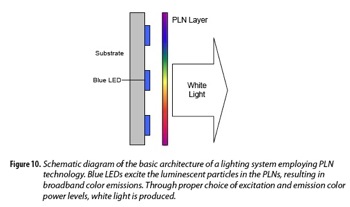
The PLN materials do not themselves emit light.  They are luminescent, which means they receive light emitted by other sources and re-emit light with a color frequency signature determined by the luminescent material.  In particular they are using a "blue LED", covering it with their PLN material, and converting the bluish light from the LED into full spectrum white light.

Pln luminescence

A poster from 2010 shows they achieve efficiencies of over 50 lumens/watt with "excellent color rendering" attributes.

Partial support for their work was provided by the U.S. Department of Energy Solid-State Lighting Core Technologies Program through award DE-FC26-06NT42860.

We should remember this sort of thing as Washington DC Politics is currently in a bitterly divided phase with narrow minded right wing ideologues claiming the Federal Government shouldn't be funding this kind of research.  They seem to have no problem with the government funding research into machines that kill people (a.k.a. weapons) so are they having some hypocrisy (or is it hypocracy) about the governments role in funding things private corporations do.   While they spouting ideology about government meddling with private corporations, this particular research would have a highly positive result, one that decreases the negative impact of our energy intensive lifestyle, and by decreasing electricity use (through improved efficiency) reduces the need to destroy the environment to get coal to run the system we live in.

Why is Washington DC Politics so hell-bent on funding research for machines to kill people, and so resistent to funding research into beneficial machines?

See below for a youtube video, a link to the research poster, and a pair of press releases concerning the technology.


Photoluminescent Nanofibers for Solid-State Lighting Applications (poster from RTI's solid state lighting research program)


Solid state lighting hr

DOE Investment Yields R&D 100 Award Winner in Energy-Efficient Lighting

September 27, 2011

RTI International's innovative nanofiber lighting technology has been honored with a 2011 R&D 100 Award. Established in 1963 by the editors of R&D Magazine, the annual R&D 100 Awards identify the 100 most significant, newly introduced research and development advances of the past year in multiple disciplines.

RTI's technology was funded in part by the U.S. Department of Energy's Office of Energy Efficiency and Renewable Energy, which supports research and development in solid-state lighting, a technology that uses highly energy-efficient semiconductors. At the core of RTI's invention is an advanced polymer nanofiber structure – a resilient material thinner than a human hair – which allows engineers to adjust the color palette of the light (or color rendering) to match the desired application. Powered by a blue light-emitting diode (LED), the RTI device produces a well-balanced white light that uses far less energy than traditional incandescent light bulbs and provides the basis for higher energy efficiency in a wide range of lighting types.

In fact, LEDs and organic LEDs (OLEDs) have the potential to be ten times more energy efficient than conventional incandescent lighting and can last up to 25 times longer. Through competitive solicitations, the Department of Energy invests in projects that advance core R&D goals, develop new products, and expand domestic manufacturing. DOE funding leverages additional private sector funding in these projects.

The Department's investments to advance solid-state lighting help accelerate the adoption of these technologies by reducing costs, enhancing product quality and performance, and saving energy and money for consumers. They also play an important role in encouraging U.S.-based manufacturing of solid-state lighting products, creating jobs, and promoting America's role as a global leader in energy efficiency.

DOE's Office of Energy Efficiency and Renewable Energy invests in clean energy technologies that strengthen the economy, protect the environment, and reduce America's dependence on foreign oil. Learn more about DOE's support of research and development of energy-efficient lighting, and visit our Energy Savers lighting choiceswebsite to start saving money by saving energy.


Join the clean energy conversation on Facebook at DOE's Energy Efficiency and Renewable EnergyEnergy Savers, and Solar Decathlon pages.


RTI International's NLITeTM Lighting Technology Earns R&D 100 Award

News Highlights

— Nanofiber lighting improvement technology (NLITe™) honored with a 2011 R&D 100 award.
— The technology provides for higher energy efficiency in a wide range of lighting types.
— Nlight can also produce an aesthetically pleasing light with better color rendering properties.


RESEARCH TRIANGLE PARK, N.C.—RTI International's nanofiber lighting improvement technology (NLITe™) has been honored with a 2011 R&D 100 award.

The annual awards, sponsored by R&D Magazine, honor the 100 most significant new technologies of the past year.

RTI's technology, which was funded in part by the Department of Energy's Solid-State Lighting program, has led to the development of high-performance, nanofiber-based reflectors that result in substantial energy savings. It has also led to the development of photoluminescent nanofibers (PLNTM) that can be used to produce an aesthetically pleasing light with better color rendering properties, especially in solid-state lighting applications.

"This breakthrough provides for higher energy efficiency in a wide range of lighting types," said Lynn Davis, Ph.D., director of RTI's Nanoscale Materials Program. "In addition, we can now adjust the appearance color palette of the light to match the desired application. Receiving this award is an honor for our team, and we are very proud of the innovation that resulted in the development of this exciting technology."

At the core of RTI's invention is an advanced nanofiber structure that provides exceptional lighting management. Nanofibers are materials with diameters and surface features much smaller than the human hair but with comparable lengths.

"We are excited that R&D Magazine has chosen to recognize this technology," said Galen Hatfield, RTI vice president of Strategic Initiatives. "Not only is it exceptionally innovative, but it represents a new platform of commercially viable materials to improve energy efficiency and appearance in lighting. We are aggressively moving this technology into the marketplace and it has captured the attention of a number of key players."

RTI also received the R&D 100 award in 2002 for thin-film and vacuum technologies, in 2004 for its syngas desulfurization technology, and in 2010 for the Nextreme thermal solutions 'hot spot' electronics chip cooler technology.


allvoices

Monday, September 26, 2011

According to Jeremy Rifkin The 'Democratization Of Energy' Will Change Everything

American economist Jeremy Rifkin has a new book out, The Third Industrial Revolution, in which he argues that the current economic woes are a symptom of a deep problem rooted in the dependence on fossil fuels.  Of course that's true and to me it's shocking that it's such an under-recognized problem.  Rather than being symptoms of a temporary economic malaise, the unemployment, rising food prices, rising debt and more are signs that the current world order -- long infused with and defined by fossil fuels -- is collapsing around us.  To understand one should study up on the role of fossil fuels in creating the marvels of our age, and then turn to studying peak oil and the collapsing supply of fossil fuels.

Ask yourself: What does Economics 101 say about "supply and demand".  When demand for some product outstrips supply, the price of that product goes up.  Yes?  Simple economics theory.  What about if that product is a fundamental requirement to keep "the economy" moving?  What if the supply of that product starts diminishing and can never again be increased?  What if a large part of the political leadership is either ignorant of the diminished supply, or in outright denial, and instead of proposing rational solutions continue to promote continued dependance on the fuel whose supply can never be increased?

That's where Peak Oil is leading us.  In Rifkin's book there have been two industrial revolutions, and that a third one is underway as we speak right now.  The third industrial revolution will lead to a grand new era of collaborative business that's more about creative play, peer-to-peer interactivity, social capital, participation in open commons and access to global networks.

The Third Industrial Revolution is the last stage of the great industrial saga and the first stage of the emerging collaborative era rolled together.  Implementation will be forced by diminishing supply of fossil fuel, and enabled by the "democratizing" influence of distributed power generation.  Distributed power generation doesn't require the top down domineering of industrialized power systems.  Somehow Rifkin believes that "we" will automatically implement democratized power as if the powers-that-be will allow it to happen.

The industrial revolutions were powered and enabled into existence by fossil fuels.  It wasn't purely intellectual genius freed from religious domination that created the industrial revolutions.  It was the harnessing of fossil fuels and the huge energy resources stored within them.  Fossil fuels like coal, oil and natural gas are reservoirs of sequestered carbon and solar energy captured millions of years ago by plants and animals.  Their dead bodies piled up and became trapped underground where natural forces converted their tissues into fossil fuels.

In the 1700's-1800's engineers and industrialists made the first steps to developing technology to mine those fuels, prepare them for industrial use, and use the energy to build vast industrial empires.  It's been a great ride, hasn't it?  However 300 years later and we're now at the mid-point of the fossil fuel resources the planet captured for us.  It's all downhill from here.  That is, the energy available from fossil fuels can only decline from here out.  And the politicians who suggest otherwise ("Drill Baby Drill") are deluded or insane or something.

Rifkin sees this third industrial revolution as a transitionary phase from industriousness to collaborativeness.  Industrial ages are characterized by "values of rigid discipline and hard work, the top-down flow of authority, the importance of financial capital, the workings of the marketplace and private property relations".  This was required by fossil fuels because of the centralized nature of fossil fuel resources.  But as fossil fuel becomes scarcer it's going to force us into a new mode of society.

Rifkin suggests the shift will rely on renewable energy resources (Solar, Wind, Biomass, etc) all of which are available "anywhere".  We won't be reliant on centralized energy resources but distributed ones.

He says "The democratization of energy has profound implications for how we orchestrate the entirety of human life in the coming century."  It means an era of distributed capitalism because energy resources are available everywhere.  He suggests the dispersed energy resources will be collected from everywhere and bundled and shared with others over a distributed "energy internet".

The distributed nature of distributed energy generation supposedly forces lateral power structures rather than the top down domineering ones of the industrial revolutions.

However - as compelling as the vision is, I wonder if the powers-that-be will allow it to take shape that way.  The powers in charge have rarely acted in the interests of individuals, and always acted in the interests of keeping those in power still in power.  Is some of the denialism about energy resource problems due to those in power trying desparately to keep the game going so they can remain in power?

It seems there's a huge interest in undermining the green tech/jobs revolution the Obama Administration wants/ed to unleash.  At the current moment we have another budget showdown in Washington DC and the government grants/loans programs for advanced green transportation technology has a gun held to its head with the Republicans saying we need to stop funding such programs in order to balance the budget.  Developing this kind of technology will act to undermine the old order of fossil fuel dependence.  Electric vehicles participate in the democratized energy system because a home owner can have enough solar panels on their house to fuel their electric car with electricity, and not have to pay anybody a dime for fuel.  Is the threats against electric vehicle technology programs meant to keep us captured by fossil fuel interests for transportation fuel?


allvoices

Chevron Energy Solutions and Marine Corps Logistics Base Albany Complete Navy's First Landfill Gas Power Plant


Landfill methane is captured and converted to 1.9 MW renewable power

ALBANY, Ga., Sept. 23, 2011 /PRNewswire/ -- Chevron Energy Solutions and the Marine Corps Logistics Base (MCLB) Albany today celebrated completion of the Department of the Navy's first landfill gas cogeneration plant.

The plant produces 1.9 megawatts of renewable electric power and steam by burning landfill gas collected from a nearby landfill. Chevron Energy Solutions also completed industrial lighting retrofits in 82 buildings and expanded the existing energy management control system. When combined with the cogeneration project, these measures reduce the base's purchase of utility power and reduce its carbon emissions by 19,300 tons annually, equivalent to removing 16,000 cars from the road.

"This project offers significant benefits to the Department of the Navy, the Marine Corps and Dougherty County," said Col. Terry V. Williams, commanding officer, MCLB Albany. "Chevron Energy Solutions has helped us surpass federal renewable energy goals in our pursuit of becoming the 'greenest' Marine Corps installation in the nation. Not only does the use of this renewable power improve the base's energy security and reliability, it also creates a valuable long-term source of revenue for the County.  This is a win-win-win."

Chevron Energy Solutions developed, designed and managed construction of the plant; and will maintain the landfill gas-to-energy facility, pipeline and processing equipment. The facility houses a dual-fuel engine generator, a stack heat recovery steam generator and two dual-fuel boilers. The primary equipment can operate on landfill gas or natural gas, which provides energy security benefits. With the addition of the plant, MCLB's power portfolio now contains 19 percent renewable power, exceeding guidelines in the EPAct of 2005 and Energy Independence and Security Act of 2007.

Chevron Energy Solutions and MCLB will co-operate the generator and steam-producing equipment. Through an Energy Savings Performance Contract (ESPC), Chevron Energy Solutions arranged the financing for the project, which is repaid through the MCLB's avoided energy costs. The company also guarantees system performance for 22 years. Chevron Energy Solutions has been actively involved with MCLB Albany's energy program since 2002, and the base recently won the 2011 Secretary of the Navy Energy and Water Management Award.

"With this new plant and the investments and participation of Dougherty County, Marine Corps Logistics Base Albany is able to extract power from an otherwise unused renewable energy source. We are proud to work with the Navy to support this award-winning energy program and to support the important mission of the Marine Corps Logistics Base," said Jim Davis, President of Chevron Energy Solutions. "This new energy plant is funded entirely through energy savings and demonstrates how military bases and local governments can work together with private industry to meet federal mandates without increasing taxpayer costs."

Dougherty County extracts and sells the landfill gas to MCLB from the Fleming/Gaissert Road Landfill, which receives approximately 100,000 tons of municipal solid waste each year. The biological decomposition of the waste generates landfill gas that is approximately 50 percent methane by volume.

The plant is being dedicated in a ceremony today, with military, government and business officials in attendance.

About Chevron Energy Solutions

Chevron Energy Solutions develops and builds sustainable energy projects that increase energy efficiency and renewable power, reduce energy costs, and ensure reliable, high-quality energy for government, education and business facilities. Its parent, Chevron Corporation, is investing across the energy spectrum to develop energy sources for future generations by expanding the capabilities of alternative and renewable energy technologies. Chevron spent approximately $4.4 billion on developing these technologies since 2002, and expects to spend more than $2.2 billion in this area between 2009 and 2011. For more information, visit www.chevronenergy.com.

About MCLB

Located in Southwest Georgia, the Marine Corps Logistics Base in Albany occupies approximately 3,600 acres within Dougherty County, and is a vital strategic asset to the Marine Corps and the nation. The mission of MCLB Albany is to provide facilities, infrastructure and a range of tailored support services enabling supported commands aboard the installation to accomplish their assigned missions in support of the warfighter. MCLB is one of the area's largest employers with more than 4,700 military, civilian and contract employees. MCLB Albany's combined military and civil service payroll exceeded $152 million in fiscal year 09.  The base is focused on being environmentally conscious and continues to look for ways to decrease use of non-renewable energy sources to increase security and reduce cost. MCLB also continues to reach out to the surrounding community to share common goals and values, and build long-lasting relationships that are good for the Corps and the community.

For more information, visit www.marines.mil/unit/mclbalbany.

Contacts:
Lt. Kyle Thomas, MCLB, 229.639.7023
Ken Pimental, Chevron Energy Solutions, 415.733.4673

SOURCE  Marine Corps Logistics Base Albany; Chevron Energy Solutions
Marine Corps Logistics Base Albany; Chevron Energy Solutions
Web Site: http://www.marines.mil/unit/mclbalbany


allvoices

CAMPAIGN CALLS ON COUNTRY’S LARGEST STADIUM TO GO SOLAR

FOR IMMEDIATE RELEASE - 26 September 2011

CONTACTS:
Monica Patel, Policy Specialist, Ecology Center, monica@ecocenter.org, (734) 369-9277
Jess Leber, Senior Organizer, Environment, Change.org, jess@change.org, (516) 658-9606

****PRESS RELEASE****

CAMPAIGN CALLS ON COUNTRY’S LARGEST STADIUM TO GO SOLAR

Over 3,000 people join popular campaign on Change.org urging the University of Michigan to join NFL’s green power trend.


ANN ARBOR, MI — More than 3,000 people have joined a campaign on Change.org calling on the University of Michigan to commit to using solar energy in its football stadium.

The campaign, created by the Ann Arbor-based Ecology Center, follows a growing NFL trend of renewable energy-powered national sports stadiums, including the homes of the Philadelphia Eagles, New England Patriots, and Washington Redskins. Activists hope the petition on Change.org will lead the University of Michigan, home to the Big 10 Wolverines and the largest-capacity stadium in North America, to become the first big-name college football school to join in.

“The UM stadium has the potential to be the largest athletic venue in North America with solar panels, which is fitting with the University’s claim to be ‘the leaders and the best’,” said Monica Patel, policy specialist at the Ecology Center. “Even though the electricity generated won’t solve the climate crisis, it will go a long way in terms of solar energy education — just think of the awareness raised among the 100,000+ fans there on Game Day, and millions of others who tune in. The move would also give real support to Michigan's growing solar energy industry."

The petition, addressed to University President Mary Sue Coleman, Athletic Director David Brandon, and Director of Campus Sustainability Initiatives Terry Alexander, is being circulated online. Supporters also plan to seek signatures at Michigan football games this fall.

“What these activists have accomplished is really impressive,” said Jess Leber, a senior organizer for Change.org, the world’s fastest-growing platform for social change. “In just a few weeks, the Ecology Center has inspired thousands of University of Michigan community members to make their voices heard on solar energy. Change.org is about empowering anyone, anywhere to demand action on the issues that matter to them, and it has been incredible to watch the Ecology Center’s campaign take off.”

In 2009, University of Michigan students completed a feasibility assessment of a stadium solar project, estimating that an installation could divert 776 tons of carbon dioxide from the atmosphere. The Ecology Center’s campaign is asking University officials to take move beyond feasibility assessments by engaging with Michigan’s solar manufacturers and developing a project to offset some of the stadium’s electricity use and feed it back into the grid during times when the stadium isn’t used.

The petition asks University of Michigan leadership to announce a commitment to solar energy at the college’s annual EarthFest this Tuesday.

Live signature totals from Ecology Center’s campaign on Change.org:
http://www.change.org/petitions/ask-the-university-of-michigan-for-solar-at-the-big-house

Comments from petition signers such as these below can be found here:

Anthony King, UM alum and Ann Arbor resident: “As an alumnus of UM, I was always taught to think of us as the leaders and best, and not just for sports. Here is an opportunity for sports and the social and academic side of the University to work together, and set an example for the nation.”

Gloria Zimet, UM alum and Ann Arbor resident: “As an Ann Arbor resident and UM alum, I see this initiative as a golden opportunity for the university and its talented students to not only support environmental sustainability, but to become nationally recognized for their leadership role by doing so at one of its most beloved and well-known arenas, the ‘Big House.’”

For more information on the Ecology Center, please visit: http://www.ecocenter.org/about/about-ecology-center

The Ecology Center is a membership-based, nonprofit environmental organization based in Ann Arbor, Michigan. Founded by community activists after the country's first Earth Day in 1970, the Ecology Center is now a regional leader that works for a safe and healthy environment where people live, work, and play. Ann Arbor 350, a project of the Ecology Center, is connected with an international campaign to unite the world around solutions to the climate crisis; scientists say 350 parts per million is the safe upper limit for carbon dioxide in the atmosphere.

For more information on Change.org, please visit: http://www.change.org/about

Change.org is the world’s fastest-growing platform for social change — growing by more than 400,000 new members a month, and empowering millions of people to start, join, and win campaigns for social change in their community, city and country.

###


allvoices